
Dare to Lead: What Brown actually means by vulnerability, and where that gets complicated

Dare to Lead: What Brown actually means by vulnerability, and where that gets complicated

A practitioner close-read of Brené Brown's Dare to Lead (Portfolio/Penguin, 2018): Brown's central argument that courage — not strategy or charisma — is the defining leadership skill, requiring vulnerability as its prerequisite. Four frameworks unpacked to operational depth: the Daring Leadership vs. Armored Leadership model, the BRAVING trust inventory (seven discrete elements), The Armory catalog of defensive deflection behaviors, and Engaged Feedback (the SFD + Support Question). Seven verbatim quotes. Practitioner evidence from r/Leadership, r/managers, and LinkedIn. A rigorous, unflinching critical assessment drawing on Rafia Zakaria's privilege analysis, Jenn M. Jackson's "courage culture" critique, and Jenny Fernandez's power-dynamics framework. Closes with five specific Monday moves derived from what practitioners report actually shifting team behavior.

Management Classics: Book Pick
2026/6/15 · 9:18
購読 1 件 · コンテンツ 5 件
Brené Brown opens Dare to Lead (Portfolio/Penguin, 2018) with a claim that reads like provocation: after interviewing hundreds of senior executives about what distinguishes the leaders they most admire, she could not find a single instance where those qualities were correlated with toughness, self-sufficiency, or emotional control. Every description, she writes, pointed in the opposite direction. 1
That's the thesis sentence of a 320-page book. Brown's central argument is this: courage is the defining skill of daring leadership, and courage requires vulnerability — the willingness to enter uncertain situations where the outcome cannot be controlled, including the conversations, conflicts, and self-disclosures that most managers are trained to avoid. 1 The book's subtitle — Brave Work. Tough Conversations. Whole Hearts. — is not inspirational shorthand. Each phrase names a terrain the frameworks are designed to navigate.
Brown, PhD, LMSW, holds a professorial appointment at the University of Houston Graduate College of Social Work, where she has been conducting qualitative research on shame, vulnerability, and human connection for more than 20 years. Her 2010 TEDx Houston talk on vulnerability went viral and was eventually folded into the main TED stage; it currently ranks among the most-watched TED talks in the platform's history. 2 Dare to Lead is her seventh book and her first explicitly framed for organizational leadership — applying a framework she had developed in earlier books (Daring Greatly, 2012; Rising Strong, 2015) to the specific context of managers, teams, and workplace culture.
The book rests on four interlocking frameworks. Together they form a diagnosis of what makes managers effective and what makes them flinch. Here is how each works in practice.

The four frameworks: a structural map

Before going deep on each piece, it helps to see how Brown intends them to fit together:
FrameworkWhat it addressesThe operational demand
Daring Leadership modelWhy armored leadership is the default and why it failsIdentify your own armor; choose the opposite behavior
BRAVING inventoryWhat trust actually requires, element by elementUse as a self-check and a team diagnosis tool
The ArmoryThe specific deflection behaviors managers use to avoid vulnerabilityName the behavior you catch yourself using; then stop
Engaged Feedback (SFD + "The Support Question")How to hold people accountable and give feedback without cruelty or coddlingStructure hard conversations so both parties feel safe enough to be honest
These are not four separate arguments. Each one addresses the same problem from a different angle: most managers have learned to manage from a defensive crouch, and the scaffolding they have built to protect themselves is the exact thing preventing the leadership behavior they claim to want.

Framework 1: Daring Leadership vs. armored leadership

Brown's core structural argument is a distinction between two modes of managing: daring leadership, which operates from the inside out (values, presence, accountability), and armored leadership, which operates from the outside in (performance, image, control). 1
The daring leadership model is built around four properties Brown calls "Rumbling With Vulnerability," "Living Into Our Values," "Braving Trust," and "Learning to Rise." She uses "rumbling" deliberately — it means sitting with discomfort rather than reflexively escaping it.
A sample of what the contrast looks like on the ground:
  • An armored leader responds to team uncertainty with "I don't want to hear about problems, I want solutions." A daring leader says: "I don't have the answer here and I need to think with you about this."
  • An armored leader gives a performance review designed to avoid HR liability. A daring leader gives feedback that makes them temporarily disliked because the other person needed to hear it.
  • An armored leader deflects a direct question about their own failure by pivoting to what the team did wrong. A daring leader names what they got wrong first.
"Daring leaders work from the assumption that people are doing the best they can. They stay curious about people's struggles and they are willing to be changed by what they hear." 1
The operational move here is specific: Brown asks leaders to identify their own "move to armoring" — the habitual behavior they use when vulnerability spikes. For some it is over-planning. For others it is sarcasm, or perfectionism, or immediately seeking expert opinions to avoid sitting with ambiguity. You cannot fix a reflex you haven't named.
One concrete practice: Brown suggests a debrief protocol after any meeting where you felt yourself shut down or armor up. Write down: What triggered me? What did I do? What did the other person need that I didn't give? This is not self-help journaling — it is a behavioral audit of the moments when your leadership cost someone something.

Framework 2: BRAVING — the trust inventory

Brown argues that trust is not a feeling — it is a set of behaviors, and those behaviors can be mapped. She uses the acronym BRAVING to identify seven discrete elements: 1
LetterElementWhat it means in practice
BBoundariesYou honor your boundaries and ask about others' — you don't assume availability or override stated limits
RReliabilityYou do what you say you'll do, at the scale you actually can commit to — not an aspirational promise
AAccountabilityYou own your mistakes, apologize, and make amends — you don't deflect, justify, or disappear
VVaultYou don't share what people confide in you — you treat information with discretion even when others don't
IIntegrityYou act from values even when it costs something, rather than choosing comfort over principle
NNon-judgmentYou can ask for help and give it without attaching shame — in both directions
GGenerosityYou interpret others' intentions as charitably as possible before deciding they were malicious or careless
The diagnostic value of this framework is in its granularity. When a relationship or a team isn't working, "we don't trust each other" is too coarse to act on. Asking "which BRAVING element is actually broken?" gives you something to address. A team may have strong accountability and poor generosity. A manager may score well on reliability and badly on the vault — they're trustworthy about delivery but gossip about their reports in ways that slowly corrode team cohesion.
"Trust is built in very small moments... It is the willingness to say 'I'm struggling' when a colleague asks how you're doing." 1
Concrete practice: Run a BRAVING self-assessment with your direct reports in a 1-on-1. Not "do you trust me?" — which is unanswerable in most organizational cultures — but: "Which of these seven elements feels shakiest between us right now?" You can also use the inventory to diagnose a difficult cross-functional relationship you've been labeling as a personality clash.
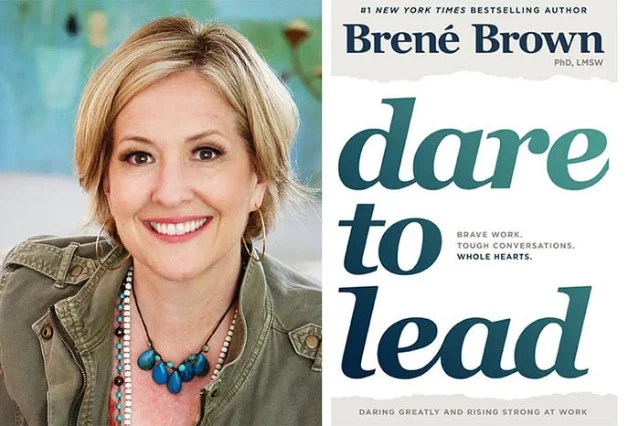
Brené Brown and Dare to Lead book cover
Dare to Lead (Portfolio/Penguin, 2018) 3

Framework 3: The Armory — recognizing your deflection behaviors

Brown's most analytically precise section is what she calls "The Armory" — a catalog of the specific protective behaviors leaders use to avoid vulnerability. This is the part of the book where recognition is the product: you read a description and think, that is exactly what I do. 1
Some of the most common pieces of armor she identifies:
Foreboding joy: When something goes well, immediately imagining the disaster that will follow rather than letting the positive moment land. Managers who compulsively identify everything that could still go wrong in a successful project are often running this pattern.
Perfectionism: Using impossibly high standards as a shield against criticism — if I preemptively criticize myself enough, no one else can hurt me. Brown distinguishes this sharply from the pursuit of excellence: perfectionism is motivated by fear of judgment, not by genuine quality standards.
Numbing: Not just alcohol or distraction, but also overwork and over-busyness as emotional management strategies. The manager who fills every hour of their calendar has often found that staying fully scheduled is an effective way to avoid feeling anything uncomfortable.
Cynicism and criticism: Pre-emptive dismissal of new ideas, other people's enthusiasm, or organizational initiatives as a way of appearing sophisticated without taking any risk. Brown notes that cynicism is often an expression of disappointment in disguise — people who care have been hurt enough times that they've made caring itself the problem.
"We cannot selectively numb emotions. When we numb the painful emotions, we also numb joy, gratitude, and happiness." 4
Operational move: Pick one piece of armor you recognize in yourself from the list above. For the next two weeks, notice every time you reach for it. You don't have to change the behavior immediately — the recognition phase precedes any change. But write down the trigger situation. Patterns in the data will tell you more than any assessment instrument.

Framework 4: Engaged Feedback — the SFD and the Support Question

Brown's feedback framework addresses a specific failure mode: leaders either avoid hard feedback to preserve the relationship, or they deliver it in ways that feel punishing. Both fail the person receiving feedback and, predictably, result in worse performance over time.
Her core tool is the SFD — which stands for "Shitty First Draft," a term she borrows from Anne Lamott's writing advice. In Brown's application, the SFD is the first story we tell ourselves about what happened — usually before we have enough information, and usually cast in the most threatening light. If your teammate misses a deadline, your SFD might be "they don't respect my time" or "they can't be trusted." Brown's technique asks you to name this story explicitly before acting on it: "The story I'm telling myself right now is..." 1
The move neutralizes a trap. Most organizational conflict escalates not because of the original event but because both parties are acting on their SFDs rather than on the actual facts.
Paired with the SFD is "The Support Question": before launching into feedback, asking the person directly, "What does support from me look like right now?" This seems simple, and it is — but most managers skip it. The result is feedback designed around what the manager needs to express, delivered in a form the recipient can't receive.
"Clear is kind. Unclear is unkind." 1
This formulation inverts the conventional politeness instinct. Managers who soften feedback to the point of meaninglessness, or avoid a hard conversation to preserve warmth, believe they are being kind. Brown's argument is that they are managing their own discomfort while leaving the other person without information they need to grow. The kind move is the clear one.
Concrete practice: The next time you need to give critical feedback, structure the conversation in three steps: (1) name your SFD explicitly — "I'm working with a story where X happened because of Y, and I want to check whether that's accurate"; (2) ask the Support Question before giving any feedback; (3) give the feedback clearly, in behavioral terms, without softening the core point.

What practitioners report

Readers who have applied the book in organizational settings divide into roughly two groups, and the split is instructive.
The first group reports genuine breakthroughs — typically around the permission-giving function of the framework. One manager in r/Leadership described how adopting Dare to Lead's language around vulnerability shifted his team's dynamics:
"Brené Brown's Dare to Lead helped me realise vulnerability isn't a sign of weakness, it's just being human. And oddly enough, practising active listening in regular 1-on-1s made my team stop seeing me as the loudspeaker and start seeing me as a partner." 5

LinkedIn practitioners in HR and learning & development tend to emphasize the "Clear is kind" principle as the most immediately translatable piece, with one noting that it reframed the obligation to deliver hard feedback from an uncomfortable choice into an ethical one. 6
When r/managers compared the book directly to Kim Scott's Radical Candor, the result was telling: readers who had worked through both rated them similarly useful but described different entry points. One commenter offered the most precise framing: "Dare to Lead is person first, whereas Radical Candor is more manager first." 7 For managers who already have command of their systems and processes and want to address interpersonal dynamics, Dare to Lead hits where Radical Candor doesn't reach. For managers building their operational baseline, the sequence goes the other way.
The second group — practitioners working in clinical, social-service, or high-pressure operational environments — describes a different experience. A social worker in r/socialwork wrote about being sent to a Dare to Lead training where the facilitator dismissed the relevance of the participant's graduate-level clinical training and spent time promoting upcoming products. 8 A mental health patient who encountered Brown's content used extensively in clinical settings — three hospitals and four outpatient facilities — described the effect in practice: "Something felt phony about her, especially in crisis." 9
The pattern that emerges: the book's value is highest when its audience has the structural safety to act on its recommendations. In environments where power is genuinely punishing, the framework's assumptions come under strain.
Professionals in a team discussion — practitioners report the highest return when the leader already has strong operational systems and wants to address interpersonal dynamics
Where practitioners report the most traction: teams whose leader has operational credibility but has learned to keep emotional distance. 5

The critique, unflinchingly

The criticism of Dare to Lead is serious and, in certain registers, devastating. It deserves its own space rather than being absorbed into qualifications.
The repackaging problem. Multiple independent Goodreads readers, including Mehrsa, Bailey L., and others, identified the book as essentially a corporate repositioning of Daring Greatly and Rising Strong, with the examples updated from personal contexts to executive settings. Mehrsa's summary: "This is Brené Brown for the corporate retreat… her good insights have been made into a bunch of buzzword-y catchphrases here, and a lot of the meaning has been lost." 10 Goodreads reader Susanna wrote that the book "could have easily been a blog post… 300+ pages of the same concept being repeated." 10 This is not a petty complaint. If you have read Brown's earlier books, there is limited new intellectual territory here.
The methodology problem. Reader Emma Deplores Goodreads Censorship (2 stars) noted a fundamental issue: "She calls herself a researcher, but vaguely mentions interviewing some people; there's no discussion of methodology or citation of statistics." 10 Reader Andy documented a further problem: Brown opens the book by claiming her methods have been validated at organizations including the Gates Foundation, but provides no evidence base for this claim anywhere in the text, and the relevant studies do not surface in public research databases. The academic community's view — per r/CriticalTheory's 339-upvote, 95%-approval thread — is blunt: one commenter summarized the consensus as "I literally thought everyone in critical studies saw her as a hack." 9
The structural power problem. This is where the critique becomes philosophically substantive. Rafia Zakaria, in a 2024 Literary Hub piece, identified a structural flaw in the core premise: Brown defines vulnerability as a choice — the decision to accept uncertainty, risk, and emotional exposure. 11 But choosing to be vulnerable requires having the option to be otherwise. As Zakaria wrote: "Brené Brown's misidentification of vulnerability as a choice exposes the privilege-dependent and white-centric cult of corporate and corporatized humanity that she has built." 11 The people who are most actually vulnerable — those exposed to poverty, structural racism, or political precarity — are not in the frame. The book's audience is assumed to be safe enough that vulnerability is a choice rather than a condition.
Jenn M. Jackson, PhD, coined the term "courage culture" in 2021 to describe this dynamic precisely. She defines it as "the white-coded myth-based belief that vulnerability is experienced homogeneously across racial, gender, sexual, class, and ability lines. It is the white-centric notion that courage (like bootstraps) will lift us up out of our present conditions without us first addressing the structural and systemic frameworks that put us there in the first place." 12 Jackson further documented how the intellectual labor underlying Brown's framework was drawn substantially from Black feminist scholarship without attribution — and that the inversion of access is telling: "we are called inaccessible, niche, and elitist, Brown (who also holds a Ph.D.) somehow fits just right." 12
Jackson's sharpest line: "Having courage to finish that swim meet or ask for that big raise isn't like having the courage to be Black in a country that wants us dead." 12
The power dynamics problem. Executive coach Jenny Fernandez (USC organizational change doctoral candidate, Thinkers50 Radar 2024) provided the most practically useful formulation of where the framework breaks down: "The issue is not vulnerability. The issue is practicing vulnerability in environments built on power, incentives, and narrative control." 13 She cited a Corporate Compliance Insights survey (October 2024) finding that 43% of US employees fear retaliation for speaking up, and that roughly half of those who do speak up experience some form of personal consequence. 13
The CMO case Fernandez describes is instructive: a female executive shared uncertainty about board expectations during a high-pressure transformation. Weeks later, that disclosure was recirculated as evidence that she was underprepared. Fernandez's gloss: "What is framed as honesty in men is often reframed as weakness or instability in women." 13
Her corrective model is worth noting because it represents what a practitioner-modified version of the framework actually looks like in use. Instead of vulnerability, she recommends what she calls "strategic disclosure" — sharing lessons learned rather than wounds still open, pairing honesty with accountability and forward direction, and building psychological safety through consistency rather than self-disclosure. "Trust grew because behavior aligned over time… Psychological safety came from reliability, not personal disclosure." 13
Senior executives in a boardroom — the context where Brown's framework was designed to operate, and where its structural assumptions are most likely to hold
The book is designed for leaders with enough organizational standing that vulnerability functions as Brown describes — a condition not shared uniformly across the workforce. 14
Brown's book does not address any of these critiques. It was published in 2018, before several of the most pointed ones appeared. But even so, the book's audience is almost exclusively assumed to be leadership at organizations stable enough that vulnerability functions as Brown describes. A Brunch Book Club reviewer noted the discomfort explicitly: readers "must be prepared to read corporate case studies and the resulting increase in revenue from improved leadership... if you're like me, hearing how much money XYZ company made from better productivity and communication can feel uncomfortable." 14 That discomfort points at the book's real scope condition: it is a book about leadership within functioning power structures, not about restructuring them.

Five Monday moves

These are derived from what practitioners report actually changing their teams, not from the most idealized reading of the book.
1. Name your armor this week. Before your next high-stakes meeting or difficult conversation, write down your "go-to" defensive behavior from Brown's armory. Pick the one you'd be most embarrassed to own. Then, during the meeting, notice once when you reach for it. You don't have to stop — just notice. Recognition has to precede change.
2. Run a BRAVING audit on one broken relationship. Pick the cross-functional relationship at work that is most frustrating you right now. Go through each BRAVING element and score it honestly (1–3 for yourself, 1–3 for the other party). Where is the specific deficit? Accountability? Generosity? Vault? The next conversation you have with that person, address the single lowest-scoring element directly instead of relitigating the last conflict.
3. Change one feedback conversation with the Support Question. In your next 1-on-1 where feedback is on the agenda, open with: "Before we get into specifics — what does support from me look like right now?" You may hear something you weren't expecting. At minimum, you will have shifted the conversation's power dynamic from evaluation to dialogue.
4. Use the SFD before one difficult email. Draft the email you need to send to someone who has disappointed or frustrated you. Before you send it, write at the top: "The story I'm telling myself is ___." Fill it in honestly. If the story is "they don't care" or "they're trying to undermine me" — ask yourself what information would change that story. Send the email only after checking whether the story can be interrogated.
5. Apply the "Clear is kind" test to your last soft-pedaled feedback. Think of the last time you gave feedback and softened the core message to the point where the person probably didn't feel the weight of it. What would you say if you committed to being clear at the cost of momentary discomfort? You don't have to reopen that conversation — but rehearse the clearer version in writing. The next time the situation recurs, you'll have the language ready.

Should you read it?

The most useful thing Dare to Lead does is give precise, nameable language to interpersonal dynamics that most managers have learned to avoid discussing. The BRAVING inventory, the armory catalog, the SFD, and the "Clear is kind" formulation are all tools a working manager can deploy on Monday morning. The book earns its shelf space on those contributions alone.
The less useful thing it does is position those tools inside a framework that assumes relatively stable power conditions, a culturally homogenous leadership context, and an organization where leaders have the latitude to be vulnerable without it being used against them. The critiques from Zakaria, Jackson, and Fernandez are not counterpoints that Brown answers — they are scope conditions the book never acknowledges having.
The honest recommendation: read it if you are a manager who has avoided the hard conversations, the transparent admissions, and the direct feedback that your team has been waiting for. The book will give you permission you may not have granted yourself, plus vocabulary that makes those behaviors easier to initiate. Read it skeptically if you are in a genuinely punishing organizational culture, operate in a context where power asymmetries make vulnerability a risk rather than a choice, or want an evidence-based model with peer-reviewed support. For those contexts, Fernandez's adaptations and the broader literature on psychological safety (Amy Edmondson's work is the empirically rigorous version of Brown's premise) will serve you better.
Dare to Lead (Portfolio/Penguin, 2018) is available in hardcover, paperback, audio, and ebook. 320 pages.

Cover image: AI-generated editorial illustration.

このコンテンツについて、さらに観点や背景を補足しましょう。

  • ログインするとコメントできます。