All Boys Aren't Blue — The Banned Memoir
George M. Johnson's memoir-manifesto: ALA's #1 most-challenged book of 2024, 39 documented bans, and why it still matters in 2026.
On November 19, 2021, Jill Woolbright, a Flagler County School Board member in Florida, filed a criminal complaint against the district superintendent. The crime she alleged: making a book available to students. The book was All Boys Aren't Blue by George M. Johnson. Woolbright cited passages describing masturbation and oral sex. 1 The Flagler County Sheriff's Office reviewed the complaint and found the book contained nothing that violated Florida law. The school board voted to retain it. The superintendent removed it anyway. 1
That sequence — challenge, criminal complaint, legal clearance, removal — compressed about three decades of book-suppression logic into a single county in a single month. And it was only the beginning. Over the next three years, All Boys Aren't Blue would climb the American Library Association's most-challenged list from third to first, rack up 39 documented challenges in 2024 alone, get banned or restricted in at least 21 school districts across 12 states, and then, in a development almost as strange as its rise, vanish entirely from the ALA's 2025 top-11 list as pressure groups pivoted to other targets. 2
No single YA memoir has concentrated more of the contemporary culture-war logic around books into a single title. Understanding what happened to it requires looking at the book itself — which turns out to be more substantive, and more deliberately provocative, than either its defenders or its opponents usually acknowledge.
The ban record: from third to first to gone
All Boys Aren't Blue appeared on the ALA's annual list of most-challenged books for four consecutive years: third in 2021, second in 2022, second in 2023, first in 2024. 3 The 39 challenges recorded in 2024 made it the most-challenged book in America that year by the ALA's count. 4 The 2025 list, released in April 2026, replaced it at the top with Patricia McCormick's Sold; Johnson's book did not appear in the top 11 at all. 2 That drop does not mean challenges stopped — the ALA documented 4,235 unique challenged titles in 2025, the second-highest total in its recorded history — but organized pressure groups appear to have rotated focus. 2
The geography of confirmed bans and challenges covers Florida (Flagler, Indian River, Brevard, and Clay counties), Missouri (Wentzville, Rockwood, and St. Joseph districts), Utah (Alpine and Canyons school districts), Kansas (Goddard Public Schools, Shawnee Heights USD 450, Salina), Virginia (Rockingham County and Bedford County), Texas (Frisco ISD), Wisconsin (Platteville), South Carolina (Pickens County), New Jersey (North Hunterdon-Voorhees), Colorado (Douglas County), and Maryland (Worcester County). 1 5
The stated reasons are consistent across jurisdictions: LGBTQIA+ content, sexually explicit material, and profanity. Secondary rationales at some districts include "inaccurate information about gender" and "promoting an unnatural gay lifestyle." 1 The actual removal outcomes vary considerably: some districts banned the book entirely, others moved it to restricted sections or required parental permission slips for checkout, and a significant number of review committees voted to retain it, only for administrators to override them — the Flagler pattern, not an anomaly.
A few cases illustrate the range. In Wentzville, Missouri, the all-white school board voted 4–3 in January 2022 to ban the book alongside Toni Morrison's The Bluest Eye, Kiese Laymon's Heavy, and Alison Bechdel's Fun Home — overriding the recommendation of its own review committee. The Missouri ACLU filed suit on behalf of two students. 1 In Utah, Alpine School District — the state's largest — used the 2022 HB 374 "Sensitive Materials in Schools" law to sweep 52 books at once, including Johnson's; 42 percent of the removed titles featured LGBTQ+ characters or themes. 5 In St. Joseph, Missouri, a challenger affiliated with the Christian nationalist Herzog Foundation demanded that the state attorney general issue arrest warrants for every school librarian in the district; after a review committee vote, the book now requires parental permission to borrow. 1 In Rockingham County, Virginia, 57 books were removed in February 2024, Johnson's among them. 1
The Douglas County, Colorado case is instructive for a different reason: the local library board unanimously rejected the removal demand. A Douglas County resident named Danny McCorkle, who is transgender, addressed the board directly: "I personally have read All Boys Aren't Blue and This Book is Gay, and I felt seen, I felt heard." 6 Library staff member Jessica Fredrickson, a co-founder of a local reader-advocacy group, summarized the floor argument more bluntly: "Just because you don't agree with something doesn't mean you get to silence it. That is not what our country is about, or at least it shouldn't be." 6
The 2025 ALA data confirms what the district-by-district pattern already suggested: this is not a dispersed, parent-led phenomenon. In 2025, 92 percent of book-removal demands came from organized pressure groups and government officials, compared to 72 percent in 2024. Fewer than 3 percent came from individual parents acting alone. 2 ALA OIF Executive Director Sarah Lamdan put it plainly: "In 2025, book bans were not sparked by concerned parents, and they were not the result of local grassroots efforts. They were part of a well-funded, politically-driven campaign to suppress the stories and lived experiences of LGBTQIA+ and BIPOC individuals and communities." 2
George M. Johnson and the book they wrote
George Matthew Johnson was born in 1985 and grew up in Plainfield, New Jersey, and Virginia. They are Black, queer, and nonbinary, and use they/them pronouns. Johnson earned a bachelor's degree from Virginia Union University, an HBCU (historically Black college or university) in Richmond, where they became a member of Alpha Phi Alpha fraternity, then a graduate degree from Bowie State University. Their journalism career has taken them through Teen Vogue, NBC, The Root, BuzzFeed, Essence, and Ebony, among others; they won the National Association of Black Journalists' Salute to Excellence Award in 2019. 7 TIME magazine named them to its 100 Next list, which tracks emerging leaders shaping their fields. 8
The trigger for the book was specific. On November 4, 2017, Giovanni Melton, a 14-year-old Black gay teenager in Nevada, was shot and killed by his father, who told police he would rather have a dead son than a gay son. 9 Johnson had been writing personal essays for years, but that story crystallized the purpose. A Toni Morrison quotation — "If there's a book you want to read, but it hasn't been written yet, then you must write it" — is tattooed on their right arm. 9 Johnson wanted to write something that could reach a Black queer teenager before their story became a tragedy.
All Boys Aren't Blue: A Memoir-Manifesto was published on April 28, 2020, by Farrar, Straus and Giroux (a Macmillan imprint). The hardcover runs 320 pages, priced at $17.99 (ISBN 9780374312718); a paperback edition at 336 pages followed at $15.99. The audiobook, narrated by Johnson, was released by Macmillan Audio and selected for YALSA's (Young Adult Library Services Association) 2021 Amazing Audiobooks for Young Adults. 10 No verified non-English translations had been published as of mid-2026, despite the book's international profile.
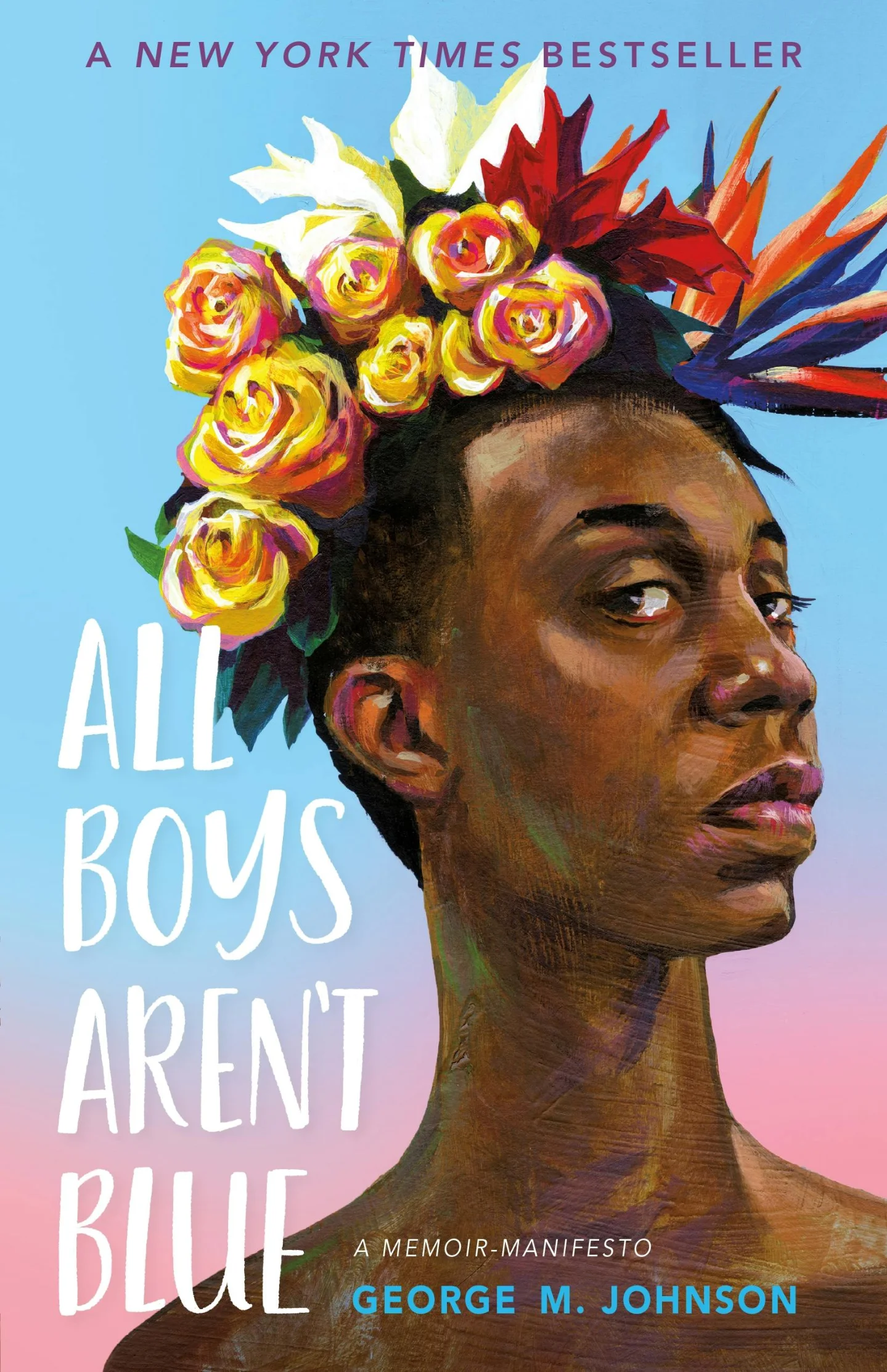
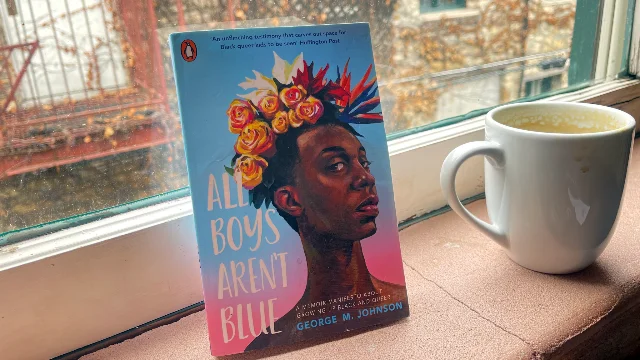
The cover, painted by Charly "Carlos" Palmer, shows a young Black man's face in three-quarter profile wearing a flower crown. The flowers are not decorative choices: the poinsettia in the center represents Johnson's grandmother Nanny, the bird of paradise is their mother's favorite flower, and the yellow roses are the symbol of Alpha Phi Alpha fraternity. 5 Johnson has said they wanted the cover to be "clearly queer" so that a young reader browsing a shelf would see themselves before opening a single page.
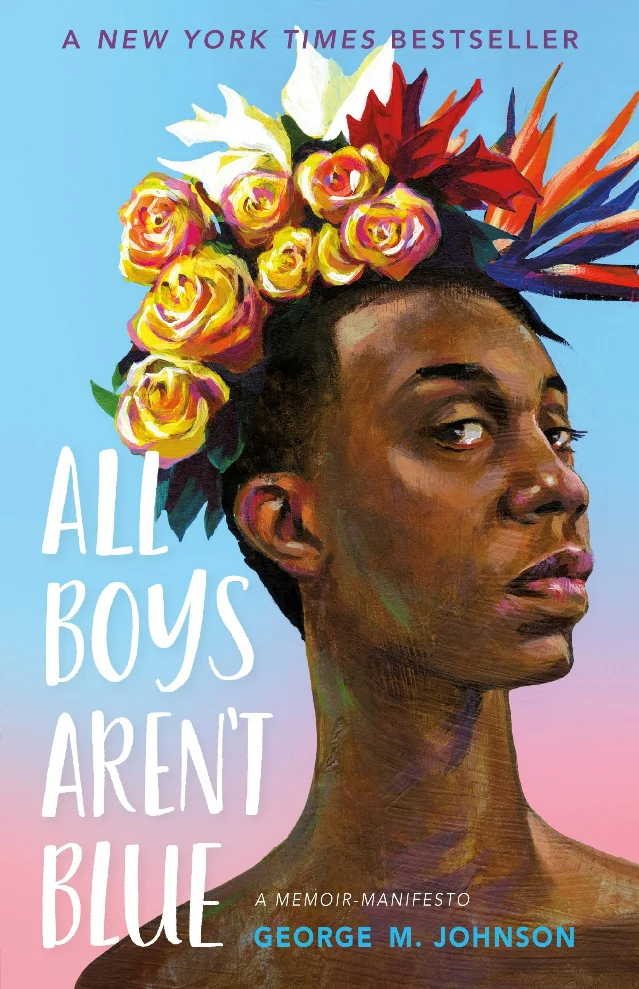
The title carries four distinct meanings Johnson has explained in interviews. "Blue" pushes back against the gendering of colors — the pink/blue binary imposed on children before they can speak. It also refers to Johnson's father, a police officer (law enforcement's "blue") who joined the force in 1978 and led its internal Black officers' organization; Johnson describes their father as someone who fully understands why Black Americans protest police violence. The third and fourth blues are literary allusions: the character Blue in Ava DuVernay's television series Queen Sugar, and the phrase from which the stage play Moonlight (and subsequently Barry Jenkins's Oscar-winning film) derives its title — "In moonlight, Black boys look blue." 5
The book is structured in four non-chronological parts, built from autobiographical essays covering Johnson's life from early childhood through age 21. Several chapters take the form of letters to family members: to grandmother Nanny, who died during the writing; to the older male cousin who sexually abused Johnson at 13; to cousin Hope, a trans woman whose visible queer joy deeply shaped Johnson's self-understanding. Johnson had originally planned the book as a resource guide — each chapter addressing a social problem with practical solutions at the end. They abandoned that structure when they recognized that many of the experiences they were writing about had no clean solutions, and that pretending otherwise would be dishonest. 5
The thematic terrain is specific and dense. The book addresses: childhood bullying severe enough to cause physical injury (Johnson's teeth were kicked out at age 5); sexual assault at 13; what Johnson calls "the mask" — the code-switching Black queer people perform to survive spaces organized around white respectability norms; the reclamation of the N-word within Black community usage; consent and sex education (Johnson wrote explicit sexual experiences as, in their words, a "road map" for young readers who lack reliable information); toxic masculinity and gender conformity (Johnson describes childhood daydreams of being a girl named Dominique, inspired by Olympic gymnast Dominique Dawes); and, counterbalancing all of it, the joy of growing up in the Elder/Johnson family — flea-market Saturdays with Nanny, fraternity brotherhood, the lightness of cousin Hope's presence. 5 9
Johnson summarized the dual audience in a 2020 NPR interview: "For some readers, I want them to feel seen. I want them to feel like there is someone in this world fighting for them and fighting for their story and right to safety and be who they are. For other readers, I want them to reflect. Reflect on the times you were the enemy in someone else's truth." 9
What the challenges were actually about
The stated reason for removing All Boys Aren't Blue from school libraries is sexual content. The review committees that actually read the book in full before voting — Rockwood (Missouri), Bedford County (Virginia), Douglas County (Colorado), Shawnee Heights (Kansas), Salina (Kansas) — voted to retain it. The boards and administrators who removed it often did so without convening full reviews, or by overriding committees that recommended retention.
Moms for Liberty, the pressure group that has been the most visible driver of book challenges nationally since 2021, deployed specific tactics against this title. In Bedford County, Virginia, the local chapter challenged 12 books simultaneously, including Johnson's. 11 In Rockwood, Missouri, affiliated parents distributed physical flyers at a school board meeting showing excerpts and illustrations from the book, framing isolated passages as evidence of obscenity — a tactic designed to shock board members and parents who had not read the book and had no context for the passages. 1 GLAAD documented the group "spreading misinformation" about Johnson's memoir specifically. 11
Johnson has described what they believe the challenges are actually about. "You can't attack something you actually don't know," they told NPR in 2022. "And this is really just an attack on an ideology, that just says that LGBTQ people shouldn't exist." 8 In a separate CBS News interview, they addressed the sexual-content framing directly: "The reality is there is no topic that is too heavy for a child who could experience said topic. If a child can experience sexual abuse at the age of seven, a child should understand what sexual abuse looks like, how to handle it, how to discuss it, and how to talk about it." 12 And in response to critics claiming the book is pornographic, Johnson told Time: "I am using my story to teach kids about the mistakes that I made the first time that I was having sex...They're leaving very, very important context out, intentionally of course, to try and say my book is pornographic." 7
There is a structural feature worth noting. All Boys Aren't Blue does not appear alone on challenge lists. It travels in a cluster: typically alongside Gender Queer by Maia Kobabe (the ALA's most-challenged book for 2021, 2022, and 2023), Flamer by Mike Curato, This Book Is Gay by Juno Dawson, Fun Home by Alison Bechdel, and Lawn Boy by Jonathan Evison. In North Hunterdon-Voorhees, New Jersey, a single parent filed formal challenges against all five simultaneously, describing them collectively as "evil and immoral." 1 The clustering is not coincidental: it reflects coordinated challenge templates distributed across chapters of national pressure groups, targeting a defined category (LGBTQ+ YA nonfiction) rather than a specific objection to any individual book.
2025–2026: the machinery accelerates
All Boys Aren't Blue may have dropped off the ALA's current top-11 list, but the legal and legislative framework being constructed around books like it has only tightened.
The most significant recent development is Mahmoud v. Taylor, decided by the U.S. Supreme Court in June 2025. The case originated in Montgomery County, Maryland, where a group of Muslim and Christian parents argued that their children's First Amendment free-exercise rights were violated when the school district used LGBTQ+-inclusive picture books without providing opt-out options. The Court ruled for the parents — a decision that, in the assessment of authors whose books were named in the case, was "designed to fuel book bans" and "designed to undermine public education," in the words of Robin Stevenson, author of Pride Puppy, one of the challenged titles. 14 PEN America's Freedom to Read senior advisor Tasslyn Magnusson described the ruling as having been "weaponized" against school libraries with "devastating impact." 14
The ruling is now being applied well beyond Montgomery County. On June 8, 2026, the Justice Department's Civil Rights Division opened compliance reviews of four California school districts — San Francisco Unified, Graves Elementary, Santa Rita Union, and Soledad Unified — evaluating whether they allow parents to opt their children out of LGBTQ+-related instruction. Assistant Attorney General Harmeet Dhillon cited Mahmoud explicitly: "Recent decisions in Mahmoud and Mirabelli have put all school districts on notice: policies that keep parents in the dark about sexuality and gender ideology in the classroom must end now." 15 Two days later, the House Education Committee — chaired by Rep. Tim Walberg (R-MI) — subpoenaed the superintendents of San Francisco Unified, Chicago Public Schools, and Loudoun County (Virginia) Public Schools to testify about their gender policies, in a hearing directly tied to HR 2616 (the "Stopping Indoctrination and Protecting Kids Act"). 16
HR 2616 passed the House on May 20, 2026, by a 217–198 vote. The bill uses federal education funding as a lever: schools that allow LGBTQ+-inclusive materials without robust parental opt-out mechanisms risk losing federal funds. As of mid-June 2026, the bill is in the Senate, where its path is uncertain. 17 PEN America's analysis points out that the bill's "parental involvement" framing misrepresents what's happening: in places that give parents genuine individual choice over their own children's reading, the overwhelming majority choose access rather than restriction. 17 What the bill actually does is give any single parent the mechanism to restrict access for all students — including those whose parents want the books available.
At the state level, Utah's book-ban machinery is the most automated. Under 2024's HB 29, any book banned by as few as two school districts (or one district plus five charter schools) must be removed from all 42 public school districts statewide — retroactively. As of June 2026, 35 books have been banned under this mechanism, with 16 of those bans occurring in 2026 alone — a single-year record. 18 All Boys Aren't Blue was among the first wave caught in Alpine and Canyons districts. Nine of Utah's 42 school districts are responsible for all 35 statewide removals; Davis School District triggered 34 of the 35. 18 Book Riot's analysis of five years of national ban data (2021–2026) found the average publication year for challenged books is 2008 — meaning most of the books being swept up sat unchallenged on library shelves through the childhoods of the adults now demanding their removal.
This is the landscape All Boys Aren't Blue entered when Jill Woolbright filed her criminal complaint in 2021. That complaint failed legally. The administrative structures now in place — state legislation that doesn't require criminal charges, federal compliance reviews that don't require a jury, opt-out mechanisms that can be leveraged by a single objecting parent — represent a more durable form of pressure than anything Woolbright could initiate in a Florida county.
Literary reception and why the critics noticed
The book's reception in 2020 was notable for its consistency. Kirkus Reviews gave it a starred review, calling it "a critical, captivating, merciful mirror for growing up Black and queer today." 10 The New York Times called it "an exuberant, unapologetic memoir infused with a deep but clear-eyed love for its subjects." 10 Booklist described it as "an absolute necessity." 10 Bitch Magazine called it "a game changer." 10 School Library Journal wrote: "The conversational tone will leave readers feeling like they are sitting with an insightful friend...Johnson anchors the text with encouragement and realistic guidance for queer Black youth." 10 Publishers Weekly noted that "in a publishing landscape in need of queer black voices, readers who are sorting through similar concepts will be grateful to join him on the journey." 19
The awards list is long for a debut: 2021 ALA Rainbow Book List Top 10, YALSA's Amazing Audiobooks for Young Adults, NYPL Best Books of 2020, Chicago Public Library Best Teen Nonfiction, Kirkus Best YA Biography/Memoir, Texas TAYSHAS Reading List. It was a Goodreads Choice Award nominee in Memoir & Autobiography, a Velshi Banned Book Club selection, and a national bestseller. 5 Gabrielle Union's I'll Have Another Productions optioned it for television development through Sony Pictures TV in June 2020; the adaptation's status as of mid-2026 is unconfirmed. 20
The critical response from Black and queer readers writing after the fact — rather than immediately on publication — has been the most revealing. KB Brookins, writing in Scalawag in 2023, described reading the chapter "Boys Will Be Boys" (the sexual assault chapter): "I wish I had a book like All Boys Aren't Blue, and a chapter like 'Boys Will Be Boys,' when I was 11 and full of questions no one was willing to answer." Brookins's conclusion was direct: "States and cities banning books like All Boys Aren't Blue are banning Black folks, queer folks, survivors, and folks who hold multiple of those identities from seeing themselves — in literature and in life." 21
Johnson has consistently framed the bans through the lens of who gets hurt. "Students have publicly said on record that works like mine have saved their lives, works like mine have helped them name their abusers, works like mine have helped them come to terms with who they are and feel validated in the fact that there is somebody else that exists in the world like them. And you want to remove that from them. I just think it's sad." 8
Worth reading?
Verdict: Yes — with a precise sense of what you're reading and who it was written for.
All Boys Aren't Blue is not a literary memoir in the tradition of, say, Between the World and Me — it does not have Ta-Nehisi Coates's formal elegance or the compression of James Baldwin, whom Johnson cites as an influence. It is angrier and more direct than that, closer in register to a long, personal letter than to crafted literary prose. Johnson periodically announces "story time" to signal a shift into anecdote. Some chapters read as essays, others as testimony. The writing varies: it can be raw and immediate on the page — especially in the assault chapter — and occasionally lapses into declarative statements that could use more scene work.
None of that undermines the book's core value. The specificity of Johnson's experience — the particular texture of growing up Black and queer in Plainfield, New Jersey, navigating a father's police identity alongside Black Lives Matter, the code-switching demanded by predominantly white spaces, the discovery of cousin Hope as a model of visible queer joy — is what makes the memoir work. This is not a general book about queerness. It is a book about a specific intersection: Black, queer, masculine-presenting, Southern-inflected, working-class family, HBCU education, fraternities. That specificity is also what made it a target: it refuses to be abstract.
Some passages carry genuine literary weight. The chapter on "the mask" — Johnson's term for the performance Black people are required to execute in white spaces — is economical and precise: "Many call it 'code switching' but it's the inability to be our truest selves when we are in certain environments that are dictated by society norms, whiteness and principles of respectability politics." 22 The observation on symbolism is one of the book's best: "Symbolism gives folks hope. But I've come to learn that symbolism is a threat to actual change — it's a chance for those in power to say, 'Look how far you have come' rather than admitting, 'Look how long we've stopped you from getting here.'" 22
Difficulty: Low to moderate. The prose is YA-accessible — no academic vocabulary, no elaborate syntax. The challenge is emotional, not technical. Several chapters deal with sexual assault and childhood violence in direct terms; readers who find that material difficult should be aware before starting.
Emotional weight: High in specific sections, lighter than the subject matter might suggest overall. The book is organized around Johnson's survival and affirmation, not their suffering; it ends in fraternity brotherhood and the recollection of cousin Hope, not in grief. But "Boys Will Be Boys" is genuinely hard to read, and it is supposed to be.
Content advisories: The book includes explicit descriptions of sexual violence (the assault at age 13), underage sexual experiences described in detail, racial slurs used in a reclaimed context, and discussions of homophobic violence. These are not incidental to the text — they are central to it. Johnson's position is that withholding this information causes more harm than providing it: "The notion that keeping vital information from people who will then learn through trial and error is a disservice to young adults everywhere." 9 That argument is the book's core, and engaging with it honestly means engaging with the material it applies to.
Who benefits most from reading this book:
- LGBTQ+ teenagers, particularly Black queer boys, for whom the primary audience representation exists
- Educators and librarians navigating book challenges who want to understand the book rather than argue about it secondhand
- Parents of queer children who want a framework for the conversations the book opens
- Readers of contemporary memoir interested in first-person accounts of intersectional identity — this sits on the same shelf as Heavy by Kiese Laymon and Know My Name by Chanel Miller, not beside literary experiments
- Anyone following the current book-ban story who wants to understand what specifically is being suppressed — the title has become a proxy for a set of political arguments, and the book itself is more specific, more honest, and harder to dismiss than its opponents would prefer
Availability: All Boys Aren't Blue is in print from Macmillan in hardcover, paperback, and audiobook formats and is widely stocked by public libraries. For readers in school districts that have removed or restricted it, the Brooklyn Public Library's "Books Unbanned" program provides free digital library cards to teenagers and young adults nationwide. Johnson has also distributed copies directly to LGBTQ+ resource centers and Little Free Libraries in areas where the book has been banned.
One of the book's central quotes requires no interpretive context: "Navigating in a space that questions your humanity isn't really living at all. It's existing. We all deserve more than just the ability to exist." 22 Whether that statement belongs in a school library is, apparently, still a contested question in 2026.
Cover image: Farrar, Straus and Giroux first edition cover of All Boys Aren't Blue by George M. Johnson, cover art by Charly "Carlos" Palmer (2020).
참고 출처
- 1Banned Books 2025 – All Boys Aren't Blue – Marshall University Libraries
- 2'Sold' Tops the List of 11 Most Challenged Books of 2025 – School Library Journal
- 3Most Challenged Books
- 4'All Boys Aren't Blue' tops the ALA's list of most challenged books in 2024 – NPR
- 5All Boys Aren't Blue – Wikipedia
- 6Douglas County library board rejects calls to ban four LGBTQ-themed books – Colorado Newsline
- 7George M. Johnson (writer) – Wikipedia
- 8George M. Johnson's 'All Boys Aren't Blue' is banned from dozens of districts – NPR
- 9'Give Them The Damn Information': Questions For George M. Johnson – NPR
- 10All Boys Aren't Blue – Macmillan Publishers
- 11Moms for Liberty Is Waging War on LGBTQ & Race-Inclusive Books – GLAAD
- 12George M. Johnson isn't surprised their book is being banned – CBS News
- 13Often protested in Kansas and across the U.S., 'All Boys Aren't Blue' has much to share – Kansas Reflector
- 14A Year After Supreme Court Decision, Kid Lit Creators are Buoyed by Community – School Library Journal
- 154 California districts face DOJ reviews over LGBTQ+ policies – K-12 Dive
- 16Congressional Republicans grill unfazed San Francisco superintendent on gender policies – EdSource
- 17Congress Seizes on 'Parents Rights' Agenda to Nationalize Censorship in Public Schools – PEN America
- 18Utah Has Banned Its 35th Book from All Public Schools – Book Riot
- 19All Boys Aren't Blue by George M Johnson – Publishers Weekly
- 20Gabrielle Union Options 'All Boys Aren't Blue' Memoir For TV Series Development – Deadline
- 21The queer survival and coming-of-age book I needed as a child – Scalawag
- 22All Boys Aren't Blue Quotes by George M. Johnson – Goodreads
이 콘텐츠를 둘러싼 관점이나 맥락을 계속 보강해 보세요.