Day 9: How much battery do you actually need? A 3-step sizing guide

Day 9: How much battery do you actually need? A 3-step sizing guide

Picking the right battery capacity is one of the most under-discussed buying decisions. This lesson gives you a 3-step framework — anchor to your real daily distance, apply the Wh ÷ 20 range rule, and adjust for hills and motor type — so you stop over-buying or under-buying. The Trek Allant+ 7 (500 Wh, ~$3,499) shows exactly how to apply the framework to a real model.

eBike School: 30-Day Daily Micro-Lessons
2026. 6. 14. · 00:19
구독 1개 · 콘텐츠 14개

Today's concept: how to pick the right battery size before you buy

Yesterday you learned the difference between hub motors and mid-drives. Today's lesson is about the other big buying variable — how much battery capacity you actually need, measured in watt-hours (Wh). 1
Pick too small and you'll run out of assist mid-commute. Buy too large and you're paying for range you'll never use — and carrying extra weight every day. The good news: a simple 3-step framework will get you close before you ever touch a spec sheet.
통계 카드를 불러오는 중…

Why Wh matters when you're shopping

Most eBike listings lead with motor wattage — "750W rear hub!" — but wattage describes power, not endurance. Wh tells you how long the battery can sustain that power. Think of it this way: wattage is engine size; Wh is the fuel tank. 2
A 750W motor with a 250 Wh battery will run out of assist in under an hour at full throttle. The same motor with a 625 Wh battery can keep going for 3–4 hours at moderate assist. Same motor, completely different riding experience.

A 3-step sizing framework

Step 1 — Nail down your real round-trip distance.
Don't use your "longest possible ride." Use the trip you'll do at least 3 times a week. If your daily commute is 12 miles round trip and you occasionally do a 25-mile weekend loop, size for the commute. You can charge every night; you don't need a reserve for a ride you take once a month.
Step 2 — Apply the range rule from Day 4.
A rough formula: estimated range (miles) = Wh ÷ 20 at moderate assist on flat terrain. For hilly routes or heavy use of high-assist, use Wh ÷ 25 instead. This gives you a conservative floor, not a marketing ceiling.
Your daily round tripRecommended minimum WhComfortable buffer Wh
Under 15 miles250 Wh400 Wh
15–25 miles400 Wh500 Wh
25–40 miles500 Wh625 Wh
40+ miles625 Wh750 Wh+
Step 3 — Factor in two Wh multipliers.
Two conditions push your effective Wh need up significantly:
  • Hills: Every 100 ft of elevation gain per mile adds roughly 10–15% more Wh consumption. A 15-mile hilly commute can consume as much energy as a 20-mile flat one.
  • Mid-drive efficiency: As you learned in Day 8, mid-drive motors use the bike's gears — this makes them more efficient on climbs. If you're buying a mid-drive, you can often drop one tier in the table above. Hub motors on hills need the larger buffer.

Real example: Trek Allant+ 7

The Trek Allant+ 7 is a commuter eBike built around the Bosch Performance Line motor and a 500 Wh battery, priced around $3,499. 3
Rider on a commuter electric bike in an urban setting, wearing a helmet
A commuter eBike with a 500 Wh battery can handle most daily round trips with charge to spare. 4
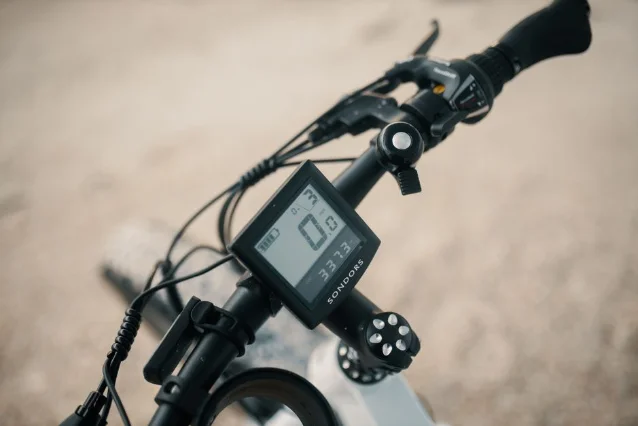
eBike display showing battery percentage and assist level on handlebars
Battery percentage is always visible on the display — the number you'll check most before a ride. 5
Trek rates it at 40–100 miles of range, which is the honest spec-sheet range: 40 miles at Sport assist with hills, up to 100 miles at Eco on flat ground. For a typical 20-mile round-trip commute with moderate hills, the 500 Wh battery has real headroom — you'd drain maybe 60–70% on a bad day, leaving plenty for the ride home without charging at work.
If your commute is under 15 miles and flat, the Allant+ 7's 500 Wh is more than you need, and a 400 Wh option from the same brand (the Allant+ 5, ~$2,499) would save you $1,000 with essentially the same daily experience. 6

One small exercise

Pull up one eBike you've been considering (or search for any Trek, Giant, or Rad Power model that interests you). Find its listed battery capacity in Wh. Then:
  1. Apply the range rule: Wh ÷ 20 (flat) or Wh ÷ 25 (hilly). Does the result cover your real daily round trip with room to spare?
  2. Check whether it has a hub motor or mid-drive. If it's a mid-drive on a hilly route, you can often get away with a smaller pack.
  3. Note the price. Compare it to the next tier up — does the extra Wh cost justify the actual extra range you'd use?
Most buyers either over-buy (paying for 625 Wh on a 10-mile flat commute) or under-buy (choosing 250 Wh for a 25-mile hilly loop). After today, you're equipped to do neither.
Tomorrow: we'll look at frame geometry — step-through vs. step-over, and why the right frame shape matters more than most buyers realize.

이 콘텐츠를 둘러싼 관점이나 맥락을 계속 보강해 보세요.

  • 로그인하면 댓글을 작성할 수 있습니다.