
The bargain that failed: Booker T. Washington's 1895 deal

The bargain that failed: Booker T. Washington's 1895 deal

In September 1895, Booker T. Washington proposed that Black Southerners accept segregation in exchange for schools, jobs, and a chance to prove their worth — then watched as the South kept building Jim Crow anyway. Wikipedia's Featured Article for June 19 is the Atlanta Compromise: the speech, the deal, the Du Bois counter-argument, and the question historians still haven't settled.

Wikipedia Featured Article
2026. 6. 19. · 08:10
구독 2개 · 콘텐츠 32개
On September 18, 1895, a 39-year-old man born into slavery stood before a segregated audience in Atlanta and proposed a deal. He spoke for fewer than ten minutes. When he finished, white Southerners in the crowd gave him a standing ovation — and then went home and kept building Jim Crow. 1
That speech, and the bargain it contained, is what Wikipedia calls the Atlanta Compromise. It is today's Wikipedia Featured Article — and it is one of the most instructive failures in American political history.
링크 미리보기를 불러오는 중…

The man and the moment

Booker T. Washington was born in 1856 in what would become West Virginia, the child of an enslaved Black woman and an unknown white man. He educated himself after emancipation, attended Hampton Institute, and by 1881 was running the newly founded Tuskegee Institute in Alabama. By 1895, he was arguably the most prominent Black leader in the South — a position that became undisputed when Frederick Douglass, the towering voice of an earlier generation, died in February of that year. 1
The Cotton States and International Exposition was a trade fair held in Atlanta, designed to showcase Southern industry and attract investment. White business leaders from Georgia had invited Washington to help pitch federal funding for the event; his address to a Congressional committee so impressed them that they asked him back to speak at the exposition itself. The master of ceremonies, former Georgia governor Rufus Bullock, introduced him with the words: "We have with us today a representative of Negro enterprise and Negro civilization." 1
The audience was segregated, as all public gatherings in the South then were. Washington spoke to both sections simultaneously — and said something different to each of them.

The terms of the deal

The Atlanta Compromise was not a written contract. It was an informal bargain, and Washington understood it as such. 1
To Black Southerners, Washington offered a path through an era of violent white supremacy: remain peaceful, accept segregation as a temporary condition, set aside demands for voting rights and political office, avoid the temptation of liberal-arts universities, and provide the skilled, reliable labor that the Southern economy needed. Stay in the South. Work hard. Build from the bottom. 1
To white Southerners and Northern philanthropists, he offered a promise in return: a cooperative, non-threatening workforce. In exchange, he asked for job opportunities, the right to own property, schools for Black children, and vocational institutes to train nurses, mechanics, farmers, teachers, and tradespeople. The funding, he acknowledged, would need to come partly from Northern white philanthropy — from organizations like the Rosenwald Fund, the Slater Fund, and the Peabody Fund. 1
The speech contained two of the most quoted sentences in American political history. On segregation, Washington offered a simile: 1
"In all things that are purely social we can be as separate as the fingers, yet one as the hand in all things essential to mutual progress."
And on the priority of economic self-sufficiency over social equality: 1
"The opportunity to earn a dollar in a factory just now is worth infinitely more than the opportunity to spend a dollar in an opera-house."
He urged Black Southerners to "Cast down your bucket where you are" — meaning: stop looking North, stop demanding rights the political climate would not grant. Build wealth and prove worth within the system as it existed. 1
The response was extraordinary. The white audience gave him a standing ovation. Clark Howell, editor of The Atlanta Constitution, stepped onto the stage and called the speech "the beginning of a moral revolution in America." The text was transmitted by telegraph to most major US newspapers. Within days, Washington received a congratulatory letter from President Grover Cleveland. 1
The Atlanta Constitution would later describe a more complicated reaction inside the hall: "tears ran down the face of many blacks in the audience. White Southern women pulled flowers from the bosoms of their dresses and rained them on the black man on stage." 1
What Washington had done, in historian Louis R. Harlan's reading, followed a specific logic: he had concluded that "the Reconstruction experiment in racial democracy failed because it began at the wrong end, emphasizing political means and civil rights acts rather than economic means and self-determination." 1
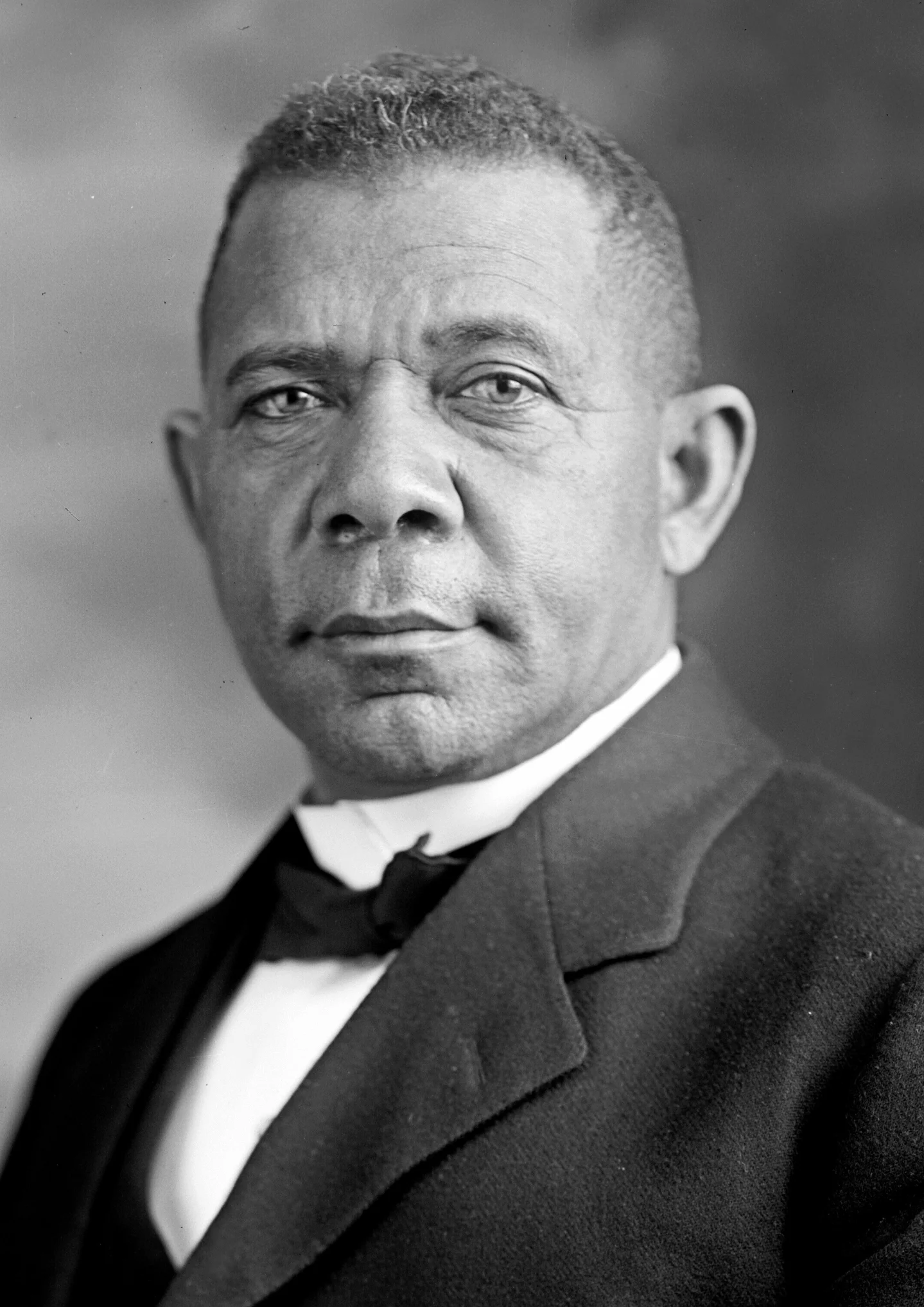
Booker T. Washington, c. 1895
Booker T. Washington, the architect of the Atlanta Compromise 1

The vocational school machine

The institutional piece of the Compromise was real and concrete. Under Washington's "Tuskegee Machine" — his network of supporters, press contacts, and philanthropic relationships — vocational schools for Black Southerners expanded significantly between 1895 and 1915. Most funding came from Northern white philanthropists who paid for thousands of school buildings and teacher salaries. 1
The model Washington championed — Tuskegee Institute, Hampton Institute — produced nurses, teamsters, farmers, housekeepers, factory workers, repairmen, teachers, and cooks. These were the skills the Southern economy needed. 1
But the emphasis on vocational education came at an explicit cost. Southern whites had a clear interest in preventing Black liberal-arts education: they feared, not unreasonably, that Black people with degrees in law, medicine, literature, or science would refuse manual labor. Fewer liberal-arts colleges were built. The career paths in law, medicine, art, history, and pure sciences were squeezed. 1
Washington also pressed his case for remaining in the South at a time when, across the country, Southern states were systematically stripping Black citizens of the vote. Poll taxes, residency requirements, subjective literacy tests — the mechanisms were not subtle. The legal disenfranchisement continued without interruption through and after Washington's speech. 1

Du Bois disagrees

W. E. B. Du Bois — Harvard-educated sociologist, born 1868 in Great Barrington, Massachusetts — had initially congratulated Washington on the Atlanta speech. The two were not yet enemies. 1
The rift opened slowly. In 1898, Washington resigned from the board of Kowaliga School, run by a friend of Du Bois. In 1900, Du Bois proposed a national organization of Black businessmen; Washington moved faster and founded the National Negro Business League, effectively pre-empting Du Bois's idea. In 1901, Du Bois gave a negative assessment of Washington's autobiography Up from Slavery. By 1903, the break was public and permanent. 1
In The Souls of Black Folk (1903) — the book in which Du Bois also coined the phrase "Atlanta Compromise" for the first time, eight years after the speech itself — he wrote: 1
"Mr. Washington represents in Negro thought the old attitude of adjustment and submission... [His] programme practically accepts the alleged inferiority of the Negro races."
Du Bois's counter-argument was not merely ideological. He had a specific critique of what the vocational emphasis was doing: 1
"[the] object of all true education is not to make men carpenters; it is to make carpenters men."
In 1904, Washington and Du Bois attempted a truce — meeting in New York, each bringing allies, forming a "Committee of Twelve" to coordinate efforts. It collapsed within a year. By 1905, Du Bois alleged in The Voice of the Negro that Washington was paying to suppress critical coverage in the Black press; Washington denied it. Historian Mark Bauerlein concluded that 1905 ended any possibility of cooperation: 1
"[From Du Bois's perspective] Washington controlled the black press, bought loyalty, planted spies, ostracized critics, and co-opted reform movements and let them die. His accommodation of whites had become too obsequious, but more important, his black power had become oppressive."
링크 미리보기를 불러오는 중…

What the Compromise actually produced

The Tuskegee Machine ran the dominant African American political operation in the South from 1895 until Washington's death in 1915. In that same period, this is what was happening in parallel: 1
Southern states continued passing Jim Crow laws without pause. Segregation was formalized in transportation, education, recreation, and social interaction. The legal architecture of white supremacy grew more comprehensive after the Compromise, not less. In 1896, the Supreme Court's Plessy v. Ferguson decision enshrined "separate but equal" as constitutional doctrine. 1
Lynchings continued at a rate of more than fifty per year until 1922 — with rare exceptions in 1907, 1914, and 1917 — and did not stop entirely until the 1940s. 1
Race massacres struck dozens of cities: Atlanta in 1906 (just eleven years after Washington's speech in that same city), Springfield, Illinois in 1908, East St. Louis in 1917, across the country during the Red Summer of 1919, and Tulsa in 1921. Du Bois believed the 1906 Atlanta massacre was partly a consequence of the Compromise itself. Ta-Nehisi Coates, writing in The Atlantic in 2009, described these episodes as "the pogroms that greeted Booker T's compromise." 1
In 1912, Woodrow Wilson was elected president — the first Democrat to hold the office since Washington's 1895 speech. Wilson refused to help Black leaders combat Jim Crow laws. During his two terms, he replaced many Black federal appointees with white ones and actively expanded racial segregation throughout the federal workforce. 1
And beginning around 1910, directly contradicting Washington's central instruction to stay in the South, millions of Black Americans began the Great Migration northward — to New York, Detroit, Chicago, Washington DC. They were voting with their feet. In 1917, Tuskegee Institute's leadership published a document urging Black Southerners to remain in the South. Du Bois responded: 1
"any ... Negro leadership today that devotes ten times as much space [in their report] to the advantages of living in the South as it gives to lynching and lawlessness is inexcusably blind."

The organizations born in opposition

In 1905, ten years after the Atlanta speech, William Monroe Trotter (founder of the Boston Guardian and a Boston-based civil rights activist), Du Bois, and their allies formed the Niagara Movement — explicitly rejecting the Atlanta Compromise and demanding full civil rights. The movement's "Declaration of Principles" urged African Americans to fight, not accommodate. 1
The Niagara Movement lasted only two years, but it seeded what came next. In 1909, Du Bois and others founded the National Association for the Advancement of Colored People (NAACP). Several of the NAACP's co-founders were liberal Northern whites who had concluded that the Atlanta Compromise would never deliver civil rights. The NAACP was well-funded, its leadership drew powerful white Northerners, and it steadily siphoned support away from the Tuskegee Machine. 1
After Washington died in November 1915, the Machine collapsed. Organized support for accommodationism as policy dissolved.
The goals Washington had promised — the end of segregation, equal rights, equal access — were not achieved in his lifetime. They required the Civil Rights Act of 1964, the Voting Rights Act of 1965, and the Civil Rights Act of 1968 to begin to become law. 1
링크 미리보기를 불러오는 중…

What historians still argue about

The Compromise's failure to deliver its stated goals is not in dispute. What historians have argued over, for more than a century, is whether Washington had any better option — and whether his private conduct tells a different story than his public one.
In the first half of the twentieth century, Du Bois's framing dominated: accommodation was a mistake, direct protest was the more effective path, and Washington had set the cause back by asking Black Americans to accept their own subordination. 1
Scholarship in the latter half of the century was more measured. Historians sympathetic to Washington argued that the South's political and economic structure left him with no realistic alternative to accommodation — that any strategy would have failed against the overwhelming force of white Southern power. Historian Robert Norrell contended that meaningful progress toward equality was structurally impossible regardless of the tactics employed, until anti-Black stereotypes were eliminated from mass media — a change that only began after World War II. 1
Mid-century research also uncovered something that complicates the picture significantly: Washington was secretly funding legal challenges to disenfranchisement, jury exclusion, and forced labor — the very injustices he appeared to tolerate in public. His private actions were not fully consistent with his public posture. The secrecy, scholars note, contributed to his early reputation as a white appeaser; it also suggests he understood, on some level, that accommodation alone would not be enough. 1
Norrell has argued that Washington's critics — especially those who came later — applied an unfair standard: 1
"Led by Du Bois ... historians confused the style with the substance of Booker T. Washington. Many historians have shown a narrow-mindedness about black leaders' styles: African-American leaders must always be 'lions' like Frederick Douglass, Du Bois, Martin Luther King Jr., or Jesse Jackson. They cannot be 'foxes' or 'rabbits', else they will be accused of lacking manhood."
The debate has never fully closed. It is, at its core, a question about what is possible when the dominant political and economic power is hostile — whether you fight openly and lose, accommodate and lose more slowly, or navigate quietly between the two. Washington tried the second option. He built real schools. He failed to stop the pogroms. Both things are true.

Memorable quotes from the Wikipedia article

Washington, at the 1895 Cotton States Exposition:
"The wisest among my race understand that the agitation of questions of social equality is the extremest folly, and that progress in the enjoyment of all the privileges that will come to us must be the result of severe and constant struggle rather than of artificial forcing."
Washington, on manual labor and dignity:
"No race can prosper till it learns that there is as much dignity in tilling a field as in writing a poem. It is at the bottom of life we must begin and not the top."
Du Bois, on the purpose of education:
"[the] object of all true education is not to make men carpenters; it is to make carpenters men."
Du Bois, in The Souls of Black Folk (1903):
"Mr. Washington represents in Negro thought the old attitude of adjustment and submission... [His] programme practically accepts the alleged inferiority of the Negro races."
Scottish essayist William Archer, on the Atlanta Compromise's ironic outcome:
"The Atlanta riot of eleven years later was a grimly ironic comment on Mr. Washington's speech."

Cover image: Booker T. Washington, formal portrait, via Wikimedia Commons (public domain).

이 콘텐츠를 둘러싼 관점이나 맥락을 계속 보강해 보세요.

  • 로그인하면 댓글을 작성할 수 있습니다.