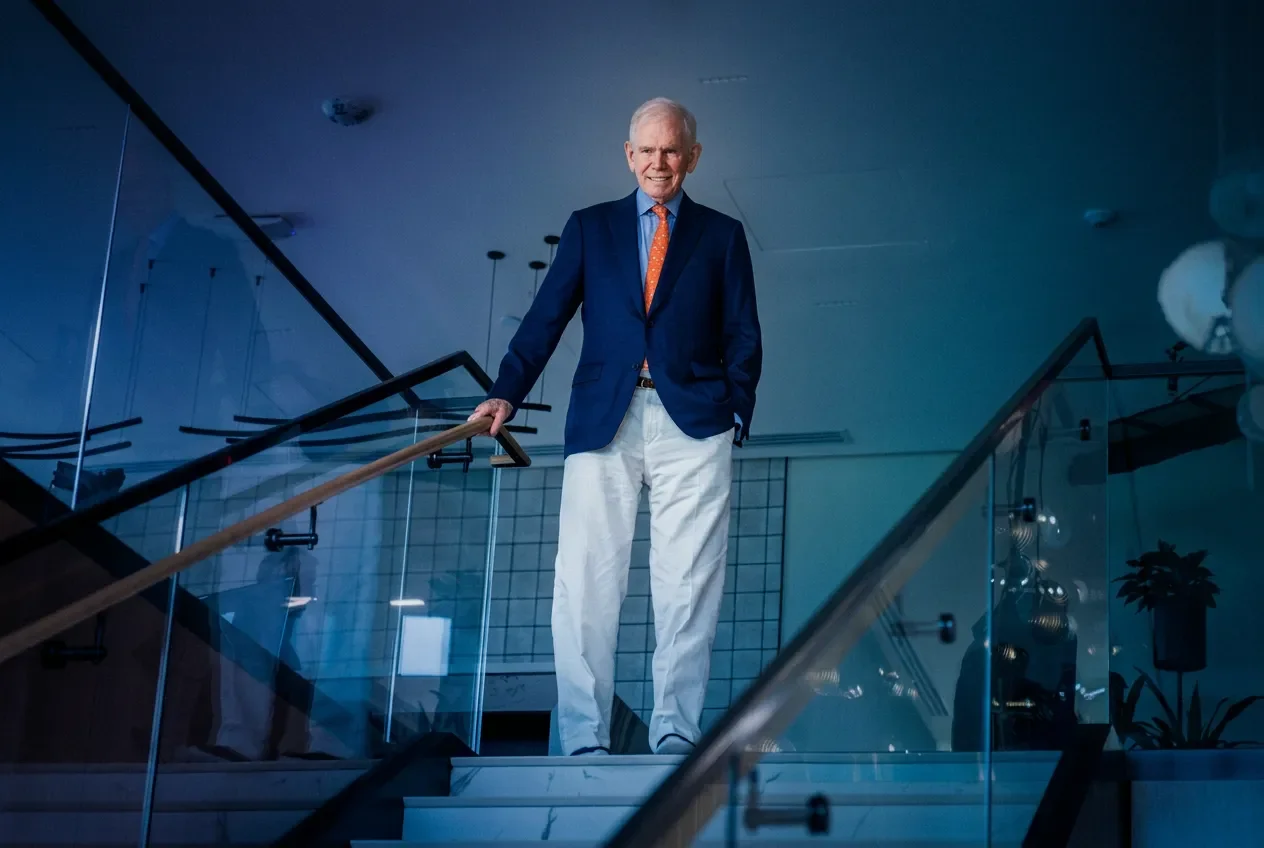
Grantham: seven monopolies just became a dogfight
Grantham's first public statement in 15 days: AI rivals railroads as history's great bubble, the Mag 7 shifted from seven separate monopolies to a capital-heavy AI dogfight, and his four-instance bubble-bursting signal is still waiting to fire.

Jeremy Grantham, co-founder and long-term strategist at GMO (Grantham Mayo Van Otterloo), broke 15 days of public silence on June 18 with his most structured bubble analysis in months — a nearly hour-long appearance on Bloomberg's Odd Lots podcast hosted by Joe Weisenthal and Tracy Alloway. 1
正在加载内容卡片…
The session covered four distinct arguments. The first is a historical ranking of bubbles. The second — and the one Grantham himself said "nobody seems to be talking about in that way" — is a structural change in the Magnificent Seven. The third is a specific market signal for spotting the moment a bubble is actually turning. The fourth is what he has and hasn't actually said about getting out.
"The internet is a bit of a piker"
Grantham's framework for ranking historical bubbles places AI alongside the 19th-century railroad boom as the only two speculative manias that merit the label "super champ." Every other bubble — including the dot-com era — falls short by comparison.
"The only one as big as AI is possibly the railroads... I am not even prepared to say it isn't bigger than the railroads. It may be, but they're the two super champs. Besides them I think the internet is, you know, a bit of a piker." 1
His logic for the railroad comparison follows the same arc: everyone could see the railroads would change the world; everyone wanted in; both sides of the Atlantic experienced catastrophic crashes; and yet the tracks, the locomotives, and the demand survived. Amazon's 92% post-1999 collapse followed by its retail dominance is the internet version of the same story.
The conditions for a great bubble, by his framework, require three things to align: decent economic times, easy money, and a "fabulous idea" with obvious world-changing potential. He describes the current environment as checking all three boxes, and adds: 1
"This is an absolute classic. It checks everything off one after another, which haven't been checked off many times in history. So this is it. If you think this is not a bubble, you are going to be in for a bit of disappointment." 1
Host Joe Weisenthal challenged the analogy by pointing to hard revenue data: Nvidia's annual sales grew from $11.7 billion in 2019 to $130 billion in 2025 — more than tenfold in six years — while Microsoft's revenue doubled from $143 billion to $280 billion over the same period. 1 Grantham didn't dismiss the numbers — he called Nvidia's gaming-chip-to-AI-chip fit "the biggest piece of luck I can think of in the last 30 years" — but argued that knowing in advance which company would capture that luck required clairvoyance, and that a head start in a capital-intensive race is still just a head start.
The Mag 7 watershed nobody is discussing
Grantham's sharpest observation in the session was structural, not about valuation multiples.
Looking backward, the Magnificent Seven each held near-monopoly positions in separate verticals: Amazon in retail, Google in search, Microsoft in software, Tesla in EVs. The Department of Justice "perfectly sound asleep," as Grantham put it, let the situation persist without breakup. 1 Looking forward, all seven are now in the same market. His characterization:
"Just imagine ten years from now looking back and saying you couldn't see the difference between seven easy monopolies and a dogfight of seven vicious, rich companies." 1
The cloud era, he noted, was a "nice well-behaved oligopoly" of three players competing politely. AI is different: it is capital-heavy (each company announcing $200 billion in annual investment as a competitive signal), it is concentrated in a single market, and there is, by his reading, only one winner at the end. 1
"It's like a watershed in almost everything that matters between the past and the future. And nobody seems to be talking about it in that way. And I don't get it." 1
Weisenthal offered a partial rebuttal: a decade ago, Google and Meta had clearly distinct businesses; now both are building foundation models and deploying hundreds of billions in capex on overlapping infrastructure. Grantham's response was essentially that this is exactly his point — the convergence itself is what investors are not pricing correctly.

The signal that has only fired four times since 1925
Grantham defines a bubble as "a rare two sigma event, based on the price only." But the more actionable part of his framework is the signal he watches for the transition from bubble-inflating to bubble-bursting.
The signal: speculative leaders start declining while the broader market continues rising. His count of confirmed instances since 1925 is four. 1
- 1929: The prior year's leading speculative stocks began declining; the S&P still rose 35% to its October peak. The low-grade stock index was already down nearly 40% before the crash completed. 1
- 1972 (the Nifty Fifty — roughly 50 blue-chip growth stocks that dominated institutional portfolios in the early 1970s): The S&P gained 17% while the average stock fell 17%. What followed was the worst bear market since the Depression — all sectors down 50%, roughly 65% in real terms. 1
- 2000: Growth stocks peaked in February and fell more than 40% while the rest of the S&P rose roughly 15% to an equal high in October. The subsequent decline ran through 2002. 1
- 2021: Meme stocks peaked mid-year and Cathie Wood's ARK Innovation funds collapsed while the S&P kept climbing. In 2022: S&P down 25%, growth stocks down 35%, the Mag 7 down 40%, bonds at their worst year in modern history. 1
His explanation for the mechanism comes from the Chuck Prince (former Citigroup CEO) framework: institutions can't stop dancing while the music plays, but they can choose to dance with Coca-Cola instead of a speculative highflier. When that rotation starts, speculative names fall in absolute terms even as blue chips hold up. The signal isn't underperformance — it's negative returns while the index is still rising.
"The one that's most interesting to me has only flashed four times since 1925... the junky fliers start to go down. It's not that they underperform a rising market. The market goes up 35% to the peak... They can't even get the sign right." 1
He acknowledged that the 2022 bear market he expected was "rudely interrupted by GPT" — a surge in AI capital expenditure that dragged animal spirits back up and created a historical anomaly with no clean precedent. He said this makes the current cycle unusually difficult to forecast.
What he has and hasn't said
Grantham was careful to distinguish his current stance from a "get out" call. He has made only two of those in his career.
The first was July 15, 2008 — a quarterly letter headlined "abandon ship, sauve qui peut," quoting the nursery rhyme "don't be brave, run away, live to fight another day," and recommending selling all emerging markets. Emerging markets halved within four months. 1
The second was late 2021 — "Let the Wild Rumpus Begin." The S&P fell 25%, growth stocks fell 35%, the Mag 7 fell 40%, and bonds had their worst year in modern history. 1
His current position is that markets are "the highest priced market in history, give or take," 1 but he has not issued a third "get out" signal.
"Now, when I want to be really bearish and recommend you get out of the market, I say so and I've only done that twice." 1
He also pointed out that his market-overpriced stance is not new: the S&P has traded at 23 times earnings for most of the 21st century, against a 20th-century norm of 15 times. He has said it was overpriced since 2000 and will keep saying so. That consistency cost GMO half its client book during the dot-com years — "famously lost half our book of business in two and a quarter years." 1
His practical advice for navigating current markets: "try and avoid the hype, check the numbers — 100 times sales pretty well does the job for you." On SpaceX, which hit a ~$2.7 trillion valuation on the recording day against $20 billion in 2025 revenue and no earnings (a price-to-sales ratio of more than 100), he said market historians in 50 years will compare its prospectus to the South Sea Bubble's — "an undertaking of such enormous value that it cannot, cannot be at this time revealed." 1
One corroborating data point
The same morning Grantham's episode went live, Ray Dalio — founder of Bridgewater Associates, the world's largest hedge fund by assets under management — posted a new video interview on LinkedIn and X warning that the U.S. is "currently on the brink" and that the period between the 2026 midterm and the 2028 presidential election will be "a particularly risky period." 3 His focus was fiscal imbalance ($7 trillion in annual federal spending against $5 trillion in revenue) and geopolitical contagion — a different analytical lens than Grantham's valuation and speculative-excess framework, but a similar broad conclusion about risk concentration.
正在加载内容卡片…
Dalio had also estimated in a LinkedIn piece published the prior week that real U.S. equity returns over the next five to ten years will run at roughly -5 to -10%, driven by extreme index concentration in AI stocks. 4 Neither investor has issued a tactical "sell now" signal, but two independent frameworks arriving at similar risk assessments on the same day — one through a bubble historian's lens, the other through a macro balance-sheet lens — is worth factoring into any portfolio review.
Cover image: AI-generated illustration.
参考来源
- 1Jeremy Grantham on How to Tell if a Bubble's About to Burst — Bloomberg Odd Lots (YouTube)
- 2Jeremy Grantham on Odd Lots — Bloomberg
- 3Ray Dalio on X: "I believe we are currently on the brink..."
- 4Ray Dalio — Investment Principles: What Should You Do Under Existing Conditions? — LinkedIn
- 5Jeremy Grantham on How to Tell If a Bubble Is About to Burst — Odd Lots on Omny.fm
围绕这条内容继续补充观点或上下文。