Sleep Research Digest Jun 7–14 2026
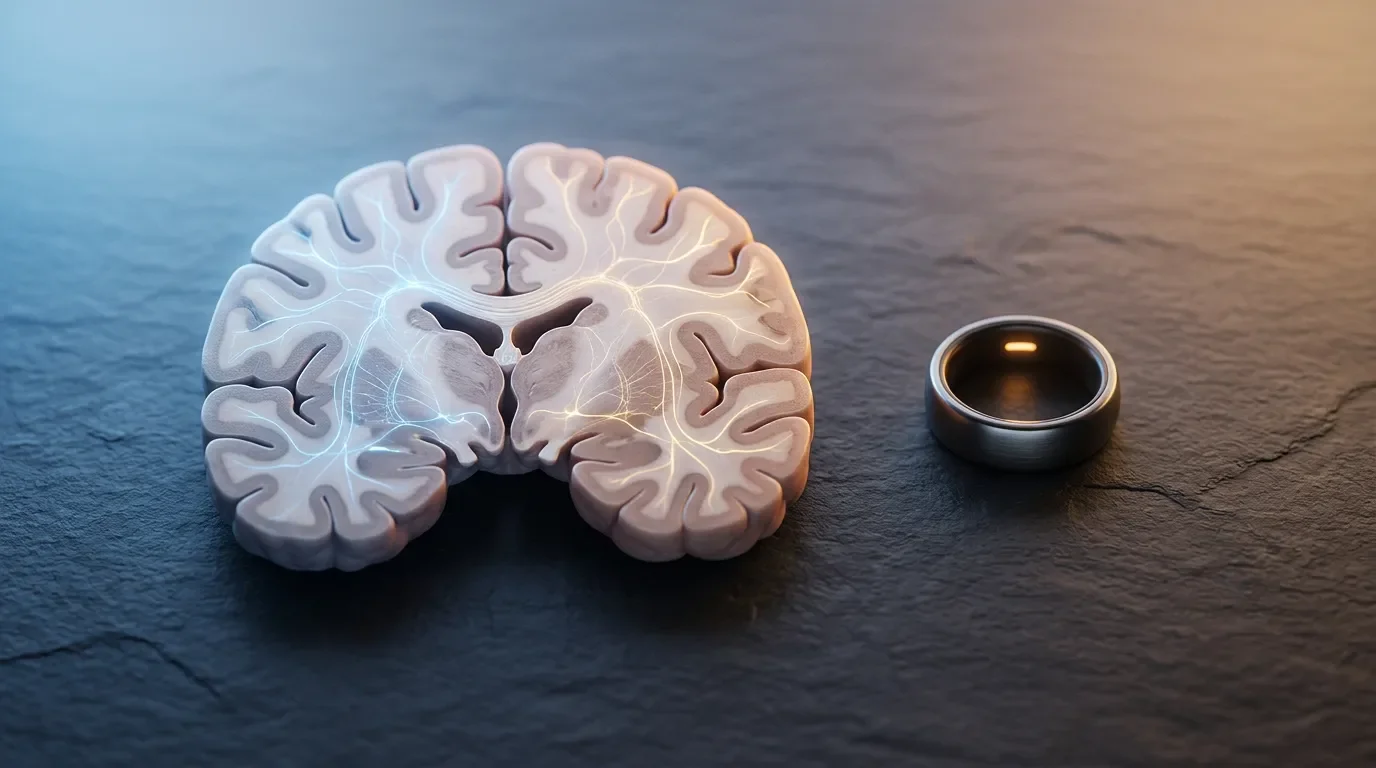
Two Nature-portfolio papers this week clarified the circuit-level mechanics of how sleep works — one showing that cortical on/off alternation rescues memory consolidation in awake mice, the other mapping how the sleeping visual cortex inverts its responses to sensory input rather than simply going offline. WHOOP published member-data analyses on CBD (+8.8 min total sleep) and sleep masks (+27 min), Oura tracked NBA Finals stress physiology at city scale, and a multi-center ML tool (ActiTect, AUROC 0.84–0.95) offered a wrist-actigraphy screen for REM sleep behavior disorder. Matthew Walker's Podcast #139 on sleep inertia supplies the week's one actionable insight: the prefrontal cortex is offline for 15 minutes after the alarm goes off, and snooze habits extend that window.
研究速览
Quick-scan: papers published June 7–14, 2026
| Paper | Journal | Design | N | Top result |
|---|---|---|---|---|
| Cortical on/off periods in awake mice fulfill sleep functions | Nature Neuroscience | Optogenetics + electrophysiology | SOM+ n=10, ACR n=8 | Induced off-cycles in awake mice rescued memory consolidation and reset synaptic strength markers |
| Cortex-specific inversion of visual responses during sleep | Nature Communications | EEG-fMRI, human | Not disclosed | Visual thalamus stays responsive; early visual cortex inverts — high-brightness stimuli cause deactivation |
| Sleep-circadian brain clearance failure in Parkinson's disease | npj Parkinson's Disease | Narrative review | N/A | Proposes sleep-circadian dysregulation as upstream driver of α-synuclein accumulation via autophagy + glymphatic failure |
| ActiTect: ML screening for REM sleep behavior disorder | npj Digital Medicine | ML tool, multi-center validation | Dev n=78; ext. cohort 1 n=113; ext. cohort 2 n=57 | AUROC 0.95 (dev), 0.84–0.94 (external cohorts) |
| REM sleep propensity measure across species | Frontiers in Neuroscience | Computational + observational | 515 human, 179 mouse, 44 rat records | REM propensity rises then falls with NREM duration — consistent across all three mammalian species |
| Sleep, anxiety, and loneliness network in Chinese elderly | Frontiers in Public Health | Cross-sectional network analysis | N=1,637 | Sleep efficiency (PSQI4) and uncontrollable worry (GAD2) are core nodes; social isolation is upstream Bayesian node |
| Exercise for sleep in Parkinson's: network meta-analysis | Frontiers in Physiology | NMA, 16 RCTs | N=932 | Aerobic exercise: SMD=−0.94 (95% CI: −1.82 to −0.07); highest SUCRA rank |
| Manual therapy for sleep disorders: bibliometric analysis | Frontiers in Psychiatry | Bibliometric | 594 publications | 5-HT and HPA-axis regulation identified as primary research frontiers |
| Insufficient sleep syndrome in children and adolescents | MDPI Children | Editorial | N/A | ~1/3 of ISS (Insufficient Sleep Syndrome) patients show SOREMPs (sleep-onset REM periods on the MSLT daytime sleep test) — easily confused with narcolepsy type 1 |
Neuroscience: what sleep actually does, now with more precision
Induction of cortical on/off periods in awake mice fulfills sleep functions
Cortex-specific inversion of visual responses during sleep
Clinical and screening
ActiTect: a generalizable machine learning pipeline for REM sleep behavior disorder screening through standardized actigraphy
| Cohort | N | AUROC |
|---|---|---|
| Development (nested cross-validation) | 78 | 0.95 |
| Local blind test set | 31 | 0.86 |
| External cohort 1 | 113 | 0.84 |
| External cohort 2 | 57 | 0.94 |
| Leave-one-dataset-out | Across all | 0.84–0.89 |
Efficacy of different exercise modalities for sleep quality in Parkinson's disease: a systematic review and network meta-analysis
Sleep in older adults: loneliness is upstream, sleep is downstream
Wearable data in the field
WHOOP member data: CBD before 10 pm, sleep masks, and what the numbers actually say

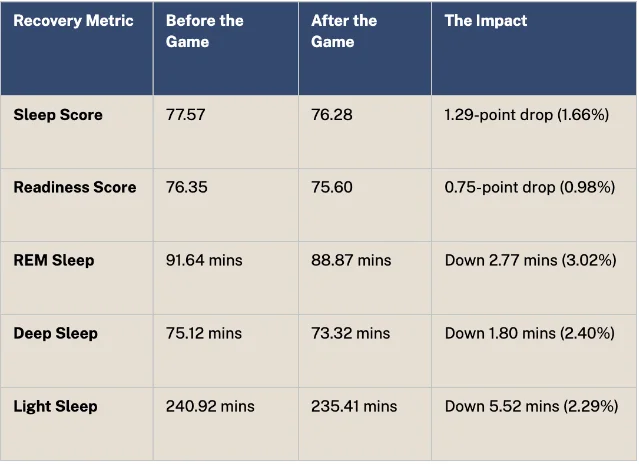
Oura's NBA Finals data story: a city's stress physiology, measured
Three consumer trackers vs. PSG: device accuracy in a clinical setting
- Apple Watch S7: Underestimated light sleep by 73.8 minutes (P<.001); overestimated REM by +30.3 minutes (P=.003). Best overall ranking.
- Fitbit Charge 5: Overestimated light sleep by +57.7 minutes (P=.009).
- Polar Vantage M2: Positive REM bias of +32.3 minutes (P=.026).
From the researchers
Matt Walker Podcast #139: the biology of sleep inertia
- Bright light on waking: activates cortical arousal faster than any supplement
- Delay caffeine: adenosine is still bound to receptors when you wake; coffee immediately after waking doesn't clear the fog, it just masks it temporarily and risks a sharper crash mid-morning
- Keep naps under 20 minutes: longer naps push into slow-wave sleep, triggering sleep inertia on the other end
- Use melodic alarms: jagged tones may amplify disorientation during the fog window
- Avoid the snooze button: "The snooze button just results in deepening the fog" — each re-entry into sleep restarts the 15-minute offline window when you wake again 11
- Hold major decisions for 15 minutes post-alarm
SLEEP 2026: what's on the agenda in Baltimore
This week's actionable insight: stop hitting snooze, and delay your first decision
- Replace your snooze habit with a single alarm + 15-minute delay protocol. Set your alarm once. When it goes off, sit up, turn on a light or open a curtain, but do not check email, make plans, or respond to messages for 15 minutes. Your Oura, WHOOP, or Apple Watch will not show you any difference — but your downstream decision quality should. The 15-minute window is the lag between brainstem wake and prefrontal wake; filling it with low-stakes activity (light exposure, stretching, a glass of water) rather than high-stakes input (news, messages, calendar) protects the cortex during its most vulnerable window.
- Check your device's sleep-stage breakdown for REM consistency over a week, not a night. The Nature Neuroscience paper this week (Driessen et al.) reinforces that slow-wave activity and rhythmicity matter more than raw duration. If your device shows REM or deep sleep collapsing below your 30-day baseline for three or more consecutive nights, that's the kind of trend signal worth acting on — not a single low-scored night.
参考来源
- 1Induction of cortical on/off periods in awake mice fulfills sleep functions
- 2Cortex-specific inversion of visual responses during sleep
- 3ActiTect: a generalizable machine learning pipeline for REM sleep behavior disorder screening through standardized actigraphy
- 4Efficacy of different exercise modalities for sleep quality in Parkinson's disease: a systematic review and network meta-analysis
- 5Network analysis of sleep disorders, anxiety, and loneliness among the community-dwelling older adults
- 6CBD and Sleep: WHOOP Data on Sleep Duration and Stages
- 7Benefits of Sleep Masks: 8 Ways to Sleep and Recover Better
- 8The Pulse of NYC: How the Knicks Playoff Drama Impacted Oura Members' Metrics
- 9Performance of three consumer sleep-tracking devices compared with polysomnography
- 10Stressed About Sleep? How to Ditch Data Anxiety & Reclaim Your Rest
- 11The Matt Walker Podcast #139: Waking Up
- 12A Clinical Preview of SLEEP 2026: Key Themes, Emerging Data, and What to Expect
围绕这条内容继续补充观点或上下文。