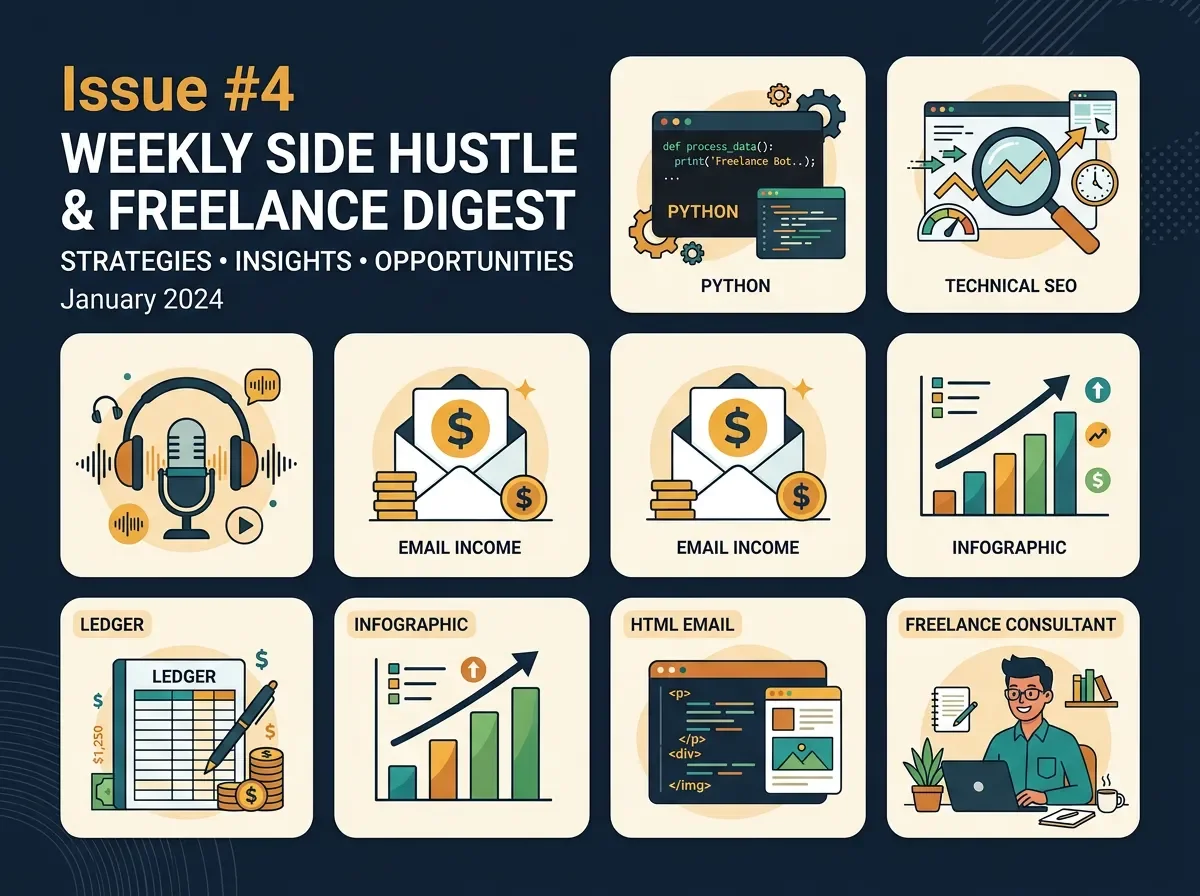
Issue #4: Eight Gigs in the Gaps — From Python Scripts to Podcast Edits
Eight scam-filtered side hustles and remote freelance gigs for developers, designers, and office workers — all new from Issues #1–3. Python automation scripting, technical SEO/Core Web Vitals auditing, ML fine-tuning/RAG implementation, infographic design, HTML email template development, podcast production/editing, email copywriting (sequences), and freelance bookkeeping. Each gig tagged [DEV], [DESIGN], or [OFFICE] with verified 2026 rate data and three concrete first steps.

Eight gigs this week that span the full stack of how remote work is actually structured right now: scripted, automated, and measured at one end; cleanly written, visually decoded, and financially tracked at the other. None of these appeared in the first three issues. All rates are sourced from 2026 data. Scam filter at the end.
At a glance
| Tag | Gig | Hourly range | Entry barrier |
|---|---|---|---|
| [DEV] | Python automation scripting | $20–$45/hr | Intermediate Python, no degree required |
| [DEV] | Technical SEO / Core Web Vitals audit | $75–$150/hr | Crawl tools, basic web dev knowledge |
| [DEV] | ML fine-tuning / RAG implementation | $50–$200/hr | PyTorch or Hugging Face experience |
| [DESIGN] | Infographic & data visualization | $15–$35/hr | Adobe/Figma, data storytelling instinct |
| [DESIGN] | HTML email template development | $30–$60/hr | HTML/CSS, ESP platform fluency |
| [OFFICE] | Podcast production & editing | $50–$150/episode | DAW basics, audio cleanup skills |
| [OFFICE] | Email copywriter (sequences) | $300–$800/email | Copywriting portfolio, niche expertise |
| [OFFICE] | Freelance bookkeeper (QuickBooks/Xero) | $25–$75/hr | QuickBooks ProAdvisor cert, 2+ yr exp |
[DEV] Python automation scripting for SMBs
Small businesses run on spreadsheets, email exports, and manual data transfers between tools that don't talk to each other. A freelance Python developer who can close those gaps earns well — not because the scripts are complex, but because the person who writes them is rare in the SMB world.
What clients actually pay for: invoice reconciliation scripts, web scrapers for price monitoring, automated report generation from Google Sheets, scheduled email digests via Gmail API, and Slack/webhook integrations. Projects rarely require machine learning or a CS degree. They require someone who ships working code within budget.
Upwork's rates page for Python lists $20–$45/hr for scripting and automation work, with experienced developers pushing $100–$150/hr on complex projects.1 The automation category on the platform grew 178% year-over-year in Upwork's 2026 in-demand skills report, cited in the same source.
Entry requirements: Intermediate Python (functions, file I/O, requests, pandas), a GitHub portfolio of 2–3 public utility scripts, and a Upwork profile with a sample project scope. No degree required.
Scam signal to watch: Clients who ask for a "test task" that is actually the full deliverable (parse 5,000 records, scrape a full site) and promise payment after. Legitimate clients pay a small fixed fee for a genuine scoping task or accept a short paid trial.
First steps:
- Publish two automation scripts on GitHub (e.g., a CSV cleaner and a simple API fetcher) with README files showing before/after output.
- Create a Upwork profile specializing in "Python automation for small business" — generic "Python developer" profiles compete against senior engineers; the niche framing targets a less crowded buyer pool.
- Browse We Work Remotely and Reddit r/forhire with filters for "Python" and "automation" — many SMB owners post there before touching Upwork.
[DEV] Technical SEO / Core Web Vitals auditing
Roughly 67% of websites fail at least one Core Web Vitals threshold, according to Ahrefs' June 2026 statistics roundup.2 That failure rate is the freelance opportunity: most site owners know their scores are poor; they don't know how to fix them, and they can't afford a retainer agency.
A freelance technical SEO auditor produces a prioritized fix list — crawl errors, Core Web Vitals bottlenecks (LCP, CLS, INP), structured data gaps, internal linking problems, and page indexation issues — then optionally implements the fixes on a project basis.
What the market pays: Upwork's technical SEO listings show $75–$150/hr for specialists, and a standalone technical audit (for a 50–500 page site) ranges from $500–$2,000 per project on the platform.3 Agencies charge $3,000–$15,000 for the same scope,4 which means a freelancer at $1,000–$1,500 is a credible discount without needing agency overhead.

Entry requirements: Screaming Frog (free tier covers up to 500 URLs), Google Search Console, PageSpeed Insights. Understanding of how JavaScript rendering affects crawl budget is a differentiator. Ahrefs or Semrush free trials are enough to generate audit screenshots for a portfolio.
First steps:
- Audit your own site or a friend's business site for free — screenshot the before/after Core Web Vitals scores to use as a portfolio case study.
- List on Upwork with a fixed-price "Starter SEO Audit" package at $299–$499 to land first reviews; once you have three 5-star reviews, move to hourly.
- Target e-commerce clients (Shopify, WooCommerce) — their site speed issues are acute, their margins are thin, and slow pages cost them measurable revenue, making the ROI conversation easy.
[DEV] ML fine-tuning / RAG implementation
LLM adoption inside companies is past the "should we try it" phase and into "why is it wrong 30% of the time." That gap — between a company that bought an AI API and a company that has a reliable internal AI tool — is where the freelance ML consultant lives.
The work breaks into two common scopes: fine-tuning (adapting an open-source model like Llama or Mistral to a client's domain and writing style) and RAG implementation (wiring a vector database to an LLM so it retrieves accurate company documents instead of hallucinating). Neither requires a PhD. Both require comfort with Python, Hugging Face, and at least one vector store (Pinecone, Weaviate, or Chroma).
Upwork's machine learning expert category lists rates of $50–$200/hr, with AI engineers listed at $35–$60/hr.1 The same platform's in-demand skills report found AI integration demand grew 178% year-over-year in 2026 — the fastest-growing freelance category tracked.1
Entry requirements: Python (PyTorch or Hugging Face transformers), at least one public RAG or fine-tuning project on GitHub, familiarity with LangChain or LlamaIndex as orchestration layers. Note: this is a genuinely technical gig — clients asking for ML implementation without a visible portfolio are a red flag on both sides.
First steps:
- Build a public RAG demo on GitHub that reads a local PDF folder and answers questions about it — a 200-line codebase is enough; add a README showing a demo conversation.
- Start with a mid-tier Upwork rate ($45–$65/hr) and explicitly state the technologies in your title: "RAG / LLM Fine-Tuning — Hugging Face, LangChain, Pinecone." Specificity filters out mismatched clients.
- Look for postings from non-tech companies (law firms, healthcare, real estate) — they have domain knowledge and often budget, but lack the engineering side.
[DESIGN] Infographic & data visualization design
When a company produces a report, a blog post, or an executive summary with five embedded tables, what they actually need is a designer who can extract the three key data points and make them scannable in 10 seconds. That's the infographic brief.
This is a gig where mid-range design skills plus a strong understanding of data hierarchy beat raw artistic ability. Clients hiring in this category are marketing teams, research firms, consulting groups, and SaaS companies — not agencies (who staff this in-house). They hire freelancers per project, often returning monthly.
Upwork's data visualization specialists list at $34/hr, with generalist graphic designers at $15–$35/hr depending on specialization and portfolio.1 Awesomic's 2026 design service report found mid-level freelance graphic designers average $35–$60/hr in the US market.5
Entry requirements: Figma, Adobe Illustrator, or Canva Pro at minimum. Strong ability to simplify — the test isn't "can you draw?" but "can you read this spreadsheet and decide what belongs in the visualization?" A portfolio of 4–6 infographics covering different data types (survey results, timeline, process flow, comparison) is the bar.
First steps:
- Find three free public datasets (Our World in Data, Census.gov, Statista free tier) and create infographics from them — these become portfolio pieces with sourced, verifiable data.
- Target mid-size content marketing agencies on LinkedIn — search for "content strategist" or "content director" at companies with 10–50 employees; they often subcontract infographic work.
- Offer a "data-to-infographic in 48 hours" package on Upwork at $150–$250 per single infographic — quick turnaround sells at this tier because the use case is editorial, not brand strategy.
[DESIGN] HTML email template development
Every ESP (email service provider) ships a drag-and-drop builder. Drag-and-drop breaks on Outlook. Outlook has a 4–6% market share in B2B, which means a broken email in every corporate inbox — and clients with agency-scale budgets who care.
An HTML email developer writes table-based HTML and inline CSS that renders correctly across Gmail, Apple Mail, Outlook 2016–365, and mobile clients. This is deliberately arcane work: table-based layouts are a throwback to 2003 web development, which keeps the supply of people who can do it thin and the demand steady.
Upwork's email marketing category shows copywriters and designers combined at $30–$60/hr for template work, with demand from e-commerce, SaaS, and agency clients. The broader email marketing freelance market, per MailerLite's May 2026 guide, has grown as brands invest more in owned channels — 75% of marketers plan to increase email spend in 2027.6

Entry requirements: HTML and CSS fundamentals, understanding of email client rendering quirks (particularly Outlook's Word rendering engine), and familiarity with at least one ESP (Klaviyo, Mailchimp, HubSpot, or MailerLite). Email on Acid or Litmus free trials let you test renders.
First steps:
- Rebuild an existing marketing email you received into hand-coded HTML — test it in Email on Acid's free trial and screenshot the before/after render results across clients.
- Look for e-commerce Shopify brands with a visible email presence but poor mobile rendering — these are your first cold-outreach targets.
- On Upwork, use "HTML email template" as your headline rather than generic "email designer" — the former attracts technical briefs; the latter attracts content briefs that pay less.
[OFFICE] Podcast production & editing
The global podcast market crossed 600 million listeners in 2025, and most independent podcasters who reach 1,000+ weekly downloads have neither the time nor the skills to edit their own audio. That's the addressable market.
A podcast editor trims filler words and dead air, normalizes audio levels, applies noise reduction, adds intro/outro music, creates chapter markers, and optionally produces show notes. The work is repetitive by design — once you have a template and workflow, a 45-minute episode takes 2–4 hours.
Upwork's podcast editing category lists $50–$200 per episode for basic to standard edits, and $200–$500 for full episode production with intro/outro and show notes.7 The Awkward Sage's 2026 cost guide corroborates this range: basic freelance editing runs $50–$150/episode for a 1-hour audio file.8
At 10 episodes per month billed at $150 each, that's $1,500/month. Ten clients at that volume would require 100 episodes — better to have 4–5 mid-tier clients at $200–$300/episode with monthly retainer agreements.

Entry requirements: Audacity (free) or Adobe Audition, noise reduction fundamentals, and a template workflow for a 45-minute show. Descript is increasingly popular with clients and worth learning — it edits audio by editing a text transcript, which speeds both client review and turnaround.
First steps:
- Edit two sample episodes from Creative Commons or openly licensed podcasts — use these as audition samples; clients almost always ask.
- Find 10–15 podcasts in a specific niche (business, true crime, health) with 1,000–10,000 monthly listeners on Spotify — message the host directly on LinkedIn or Instagram with a one-paragraph pitch and a sample of your work.
- Offer the first episode free to land a retainer; one satisfied client in a niche tends to refer three others.
[OFFICE] Email copywriter (sequences and campaigns)
Email has the highest ROI of any digital marketing channel — $10–$36 returned per dollar spent, per Litmus's ongoing research cited in MailerLite's 2026 guide.6 That ROI pressure means email copywriters who can write sequences that convert get treated as revenue generators, not vendors.
The work: writing welcome sequences, abandoned cart flows, post-purchase nurture, re-engagement campaigns, and promotional emails. Email copy differs from blog copy in that every sentence is competing against inbox noise — subject lines determine whether anyone reads anything; body copy determines whether anyone clicks.
What the market pays: SoloPricing's 2026 rate survey (sourced from AWAI and Freelance Writers Den) puts mid-level email copywriters (3–5 years) at $85–$160/hr, with per-email project rates at $300–$800 per individual marketing email, and $1,500–$5,000 for a full 5–7 email welcome sequence.9 Upwork confirms beginner copywriters start at $15–$30/hr while specialists in conversion copy reach $75–$150+/hr.1
Entry requirements: A portfolio of at least one complete email sequence (minimum 3 emails) — real, speculative, or rewritten from a live brand. Subject line/open rate data from a real campaign, if available, is a strong differentiator. No degree required; results are the credential.
First steps:
- Write a speculative 5-email welcome sequence for a DTC brand you admire — post it publicly on a portfolio site (Contently, Clippings.me, or a personal site).
- Cold-pitch to e-commerce brands using Shopify's public store directory — filter for brands with an email capture on their homepage but no visible nurture sequence; that's your pitch hook.
- On Upwork, position as "email sequence copywriter" rather than "copywriter" — the niche framing gets you in front of buyers with a specific brief instead of competing against every content writer on the platform.
[OFFICE] Freelance bookkeeper (QuickBooks / Xero)
Remote bookkeeping is one of the most durable freelance categories. The demand is structural — every business with revenue over ~$50K/year needs someone keeping the books — and the barrier to AI replacement is higher than it looks (bank reconciliation and transaction categorization sound automatable until you hit edge cases, which are constant in small business bookkeeping).
The scope: bank and credit card reconciliation, accounts payable and receivable, monthly close, payroll processing, and 1099/W-2 preparation. Clients range from solo consultants who hate QuickBooks to 5-person retail operations trying to stay tax-compliant.
QuickBooks' own rate guide puts the median freelance bookkeeper at nearly $24/hr and climbing toward $28/hr in 2026.10 The more detailed Zedtreeo rate survey (April 2026, sourcing Upwork data and Glassdoor benchmarks) puts US freelance bookkeepers at $25–$75/hr depending on experience level: entry-level $20–$30/hr, mid-level $30–$50/hr, and senior/specialist $50–$100+/hr.11 Monthly retainer engagements typically run $300–$2,500/month depending on transaction volume.
Entry requirements: QuickBooks Online ProAdvisor certification (free from Intuit), Xero or FreshBooks as a second platform, 2+ years of bookkeeping experience (accounting firm, in-house, or self-taught with real client work). A cleanup project in your portfolio — showing a messy set of books you reconciled — is the most persuasive proof of competence.
First steps:
- Earn QuickBooks Online ProAdvisor certification through Intuit's free program — the badge appears in Intuit's ProAdvisor finder directory, which sends inbound leads.
- Find initial clients through your local chamber of commerce or networking groups (BNI, local small business Facebook groups) — bookkeeping is trust-heavy; warm referrals convert far better than cold Upwork applications.
- Price with a monthly retainer structure from day one — hourly billing incentivizes slowness; a flat monthly fee signals professionalism and stabilizes your income.
Scam filter
These patterns appeared in freelance listings this week. Skip any posting that matches.
Upfront payment or "training fee": No legitimate freelance client asks you to pay for software, tools, or a training course before work begins. This is universal to all gig categories.
Vague high-pay for simple tasks: "Review products and earn $500/day" or "Easy data entry, $80/hour, no experience needed." If the pay is disproportionate to the described complexity, it is not what it claims to be.
Immediate off-platform move: A client who contacts you through Upwork or Contra and immediately asks to move to WhatsApp, Telegram, or personal email before any contract is signed is bypassing platform protections. Platform protections exist for your benefit.
Zero-review client, large first project: A client with no reviews asking for a $3,000+ initial engagement is not categorically a scam, but it warrants a video call, a clear written scope, and milestone-based payment — not a lump sum upfront.
"Portfolio test" that is the actual deliverable: A paid trial task is legitimate; a 20-hour unpaid "test" that produces finished work is not. Legitimate auditions are short (1–2 hours), clearly scoped, and often compensated.
参考来源
- 1Upwork: How Much Do Freelancers Make in 2026
- 2Ahrefs: 107 SEO Statistics for 2026
- 3Upwork: Best Technical SEO Freelancers for Hire
- 4Digital Applied: SEO Pricing 2026
- 5Awesomic: Top 5 Design Service Models in 2026
- 6MailerLite: Freelance Email Marketing Career Guide
- 7Upwork: Best Freelance Podcast Editors for Hire
- 8Awkward Sage: How Much Does Podcast Editing Cost in 2026
- 9SoloPricing: Freelance Copywriter Rates in 2026
- 10QuickBooks: How Much Does a Bookkeeper Cost in 2026
- 11Zedtreeo: Freelance Bookkeeper Rates 2026
围绕这条内容继续补充观点或上下文。