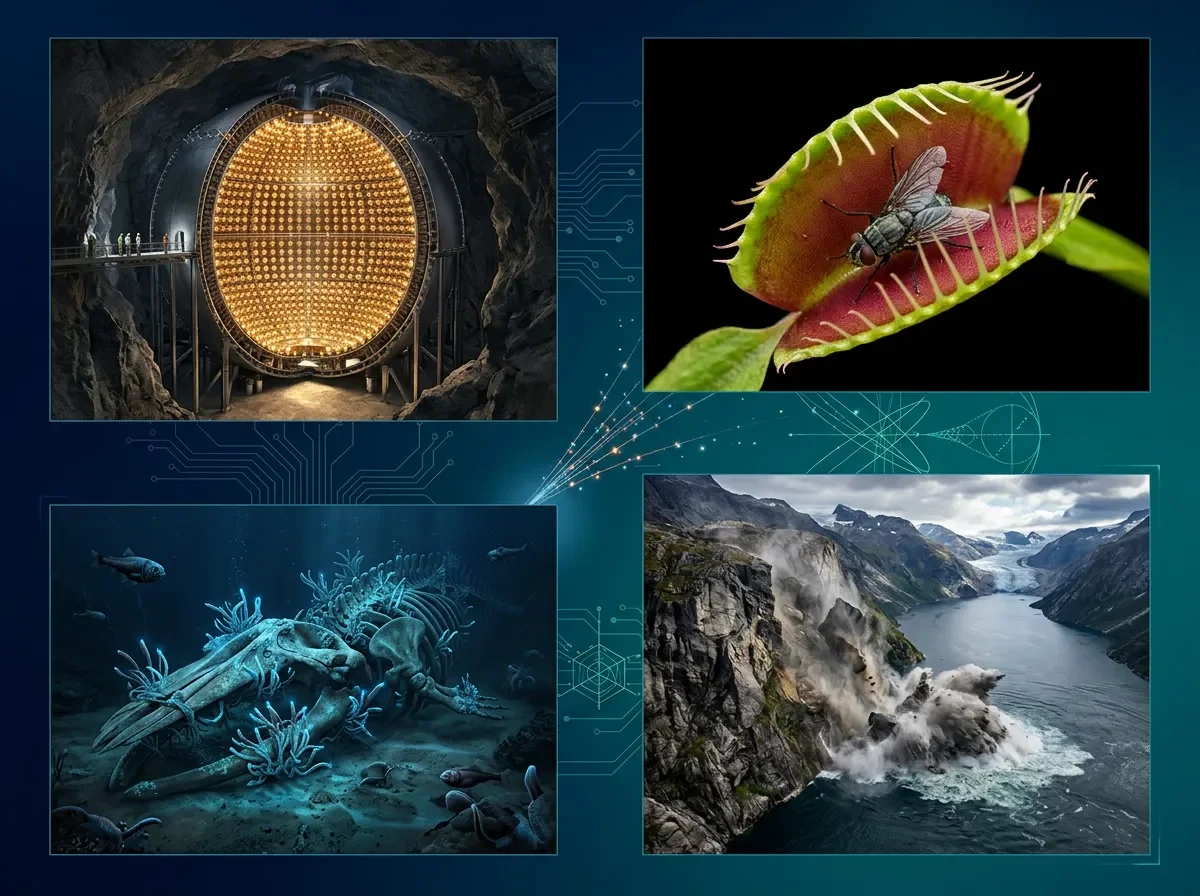
This week in Nature & Science: underground neutrinos, a snapping plant mystery solved, 5-million-year whale bones, and an Alaskan near-miss
A cross-disciplinary digest of the five highest-attention papers from Nature Vol. 654 Issue 8118 and Science Vol. 392 Issue 6803, both published June 10–11, 2026. #1: JUNO measures two solar neutrino oscillation parameters from only 59.1 days of data — 1.6× more precisely than all previous experiments combined, sharpening a persistent discrepancy that may point beyond the Standard Model. #2: Venus flytraps close by rapid cell-wall softening, not water transport; a near-miss Alaska megatsunami (481 m runup) generated by glacial-retreat-triggered rock failure rounds out a cross-disciplinary issue spanning particle physics, plant biomechanics, paleontology, quantum computing, and geohazards.
研究速览
Nature Vol. 654 Issue 8118 (June 10, 2026) and Science Vol. 392 Issue 6803 (June 11, 2026). The five entries below are ranked by combined social discussion signal and scientific significance. Altmetric scores are unavailable for this window — papers published June 10–11 have had at most 48 hours to accumulate post-publication attention, and most academic discussion lags publication by several days. Rankings reflect observed X/Twitter engagement, external media pickup, Crossref early citation counts, and cross-disciplinary significance.
| Rank | Paper | Journal | Discipline | Open access |
|---|---|---|---|---|
| #1 | JUNO first neutrino oscillation results | Nature 654, 8118 | Particle physics | No |
| #2 | Venus flytrap closure mechanism | Science 392, 6803 | Plant biomechanics | No |
| #3 | 5.3-million-year deep-sea whale necropolis | Nature 654, 8118 | Paleontology / deep-sea ecology | Yes ✅ |
| #4 | Trapped-ion quantum error correction | Nature 654, 8118 | Quantum computing | No |
| #5 | Alaska 481-meter landslide-tsunami | Science 392, 6803 | Geohazards / seismology | No |
#1 — JUNO measures neutrino mixing with 1.6× the precision of all previous experiments combined
Journal: Nature Vol. 654, Issue 8118 (June 10, 2026) · DOI: 10.1038/s41586-026-10538-z
Discipline: Particle physics / neutrino oscillation
Collaboration: JUNO Collaboration — 700+ scientists across 17 countries; led by the Institute of High Energy Physics, Chinese Academy of Sciences (IHEP-CAS)
Open access: No (paywalled); Nature News & Views companion included in same issue
Social signal: ~89 likes / 22 retweets on X within 48 h; Science magazine news article published same day
Discipline: Particle physics / neutrino oscillation
Collaboration: JUNO Collaboration — 700+ scientists across 17 countries; led by the Institute of High Energy Physics, Chinese Academy of Sciences (IHEP-CAS)
Open access: No (paywalled); Nature News & Views companion included in same issue
Social signal: ~89 likes / 22 retweets on X within 48 h; Science magazine news article published same day
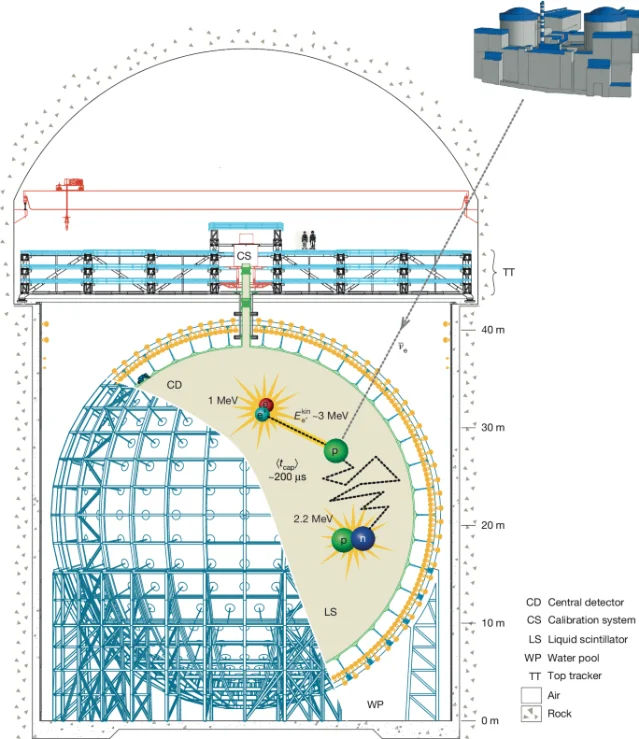
Core finding: The Jiangmen Underground Neutrino Observatory (JUNO), a 20-kiloton liquid-scintillator detector buried 700 m underground in Guangdong Province, China — positioned 52.5 km from multiple reactor cores — released its first physics results from only 59.1 days of data collected after detector completion in August 2025. From that single run, the collaboration simultaneously measured two solar neutrino oscillation parameters with precision surpassing the combined legacy of all prior global experiments: sin²θ₁₂ = 0.3092 ± 0.0087 and Δm²₂₁ = (7.50 ± 0.12) × 10⁻⁵ eV² (assuming normal mass ordering). The overall precision improvement is 1.6× over the KamLAND plus solar neutrino dataset that represented the state of the art. 1
Why the 59-day figure matters: Previous constraints on sin²θ₁₂ and Δm²₂₁ accumulated over decades across multiple experiments (Borexino, SNO, Super-Kamiokande, KamLAND). JUNO reaching and then exceeding that combined precision from a two-month commissioning dataset reflects both the instrument's scale — 17,612 large photomultiplier tubes arranged on a 35.4-meter-diameter sphere — and the engineering decision to run immediately after detector completion rather than waiting for calibration completeness. 1
The solar neutrino tension: The new result sharpens what physicists call the "solar neutrino tension" — a persistent discrepancy between the θ₁₂ value inferred from solar neutrino experiments (Borexino, SNO) and the value from reactor experiments (KamLAND). The gap has sat at roughly 1.5–2σ for years; JUNO's higher-precision reactor measurement now places the tension on firmer statistical ground, and some physicists read it as a hint of physics outside the Standard Model neutrino sector, though nothing rises to discovery threshold yet. 1
What JUNO is designed to determine next: These θ₁₂ / Δm²₂₁ results are a commissioning proof-of-concept. JUNO's primary physics goal — distinguishing normal from inverted neutrino mass ordering — requires measuring the much smaller parameter Δm²₃₁ at per-mille precision over several years of full-statistics running. That measurement would resolve the only remaining discrete ambiguity in the neutrino Standard Model. 1
#2 — Venus flytraps close in under a second by softening cell walls, not pumping water
Journal: Science Vol. 392, Issue 6803 (June 11, 2026) · pp. 1183–1187 · DOI: 10.1126/science.aed5051
Discipline: Plant biomechanics / cell biophysics
Authors: Jeongeun Ryu, Mathieu Colombani, Corentin Mollier, Joël Marthelot, Yoël Forterre — Aix-Marseille Université / CNRS / IUSTI / Turing Center for Living Systems, Marseille, France
Funding: H2020 European Research Council (grant 647384)
Open access: No (paywalled); full media coverage available via ABC Australia, The Guardian, Reuters
Social signal: Science cover story; media pickup from ABC Australia, The Guardian, Reuters within 24 h of publication; classified as highest-media-attention Science paper this issue
Data: Zenodo · doi:10.5281/zenodo.17454683
Discipline: Plant biomechanics / cell biophysics
Authors: Jeongeun Ryu, Mathieu Colombani, Corentin Mollier, Joël Marthelot, Yoël Forterre — Aix-Marseille Université / CNRS / IUSTI / Turing Center for Living Systems, Marseille, France
Funding: H2020 European Research Council (grant 647384)
Open access: No (paywalled); full media coverage available via ABC Australia, The Guardian, Reuters
Social signal: Science cover story; media pickup from ABC Australia, The Guardian, Reuters within 24 h of publication; classified as highest-media-attention Science paper this issue
Data: Zenodo · doi:10.5281/zenodo.17454683
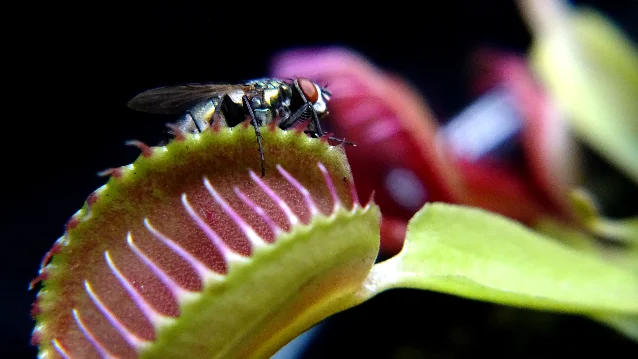
Core finding: The Venus flytrap (Dionaea muscipula) closes its trap in roughly 100 milliseconds — too fast to be explained by water moving between cells, the mechanism that textbooks and most research have assumed. Ryu and colleagues immobilized traps with dental resin and used a nanoindenter to measure the stiffness of epidermal cell walls in real time before, during, and after a triggered closure. Cell wall stiffness dropped by a measurable factor within approximately one second of stimulation — consistent with elastic energy release — while time-resolved modeling ruled out hydraulic transport on physical grounds: water cannot redistribute fast enough through cell-to-cell pathways to account for the observed speed. This represents the fastest modulation of mechanical wall properties ever reported in any plant tissue. 2
Expert reaction: Senior author Yoël Forterre described the outcome as unexpected: "What surprised us most was not only that water transport turned out to be too slow, but also that the mechanical signature of closure pointed so clearly to a rapid softening of the cell wall." 3 Kim Johnson of La Trobe University, who was not involved in the study, called the demonstration of speed "really novel." 3
A dissenting view on the record: Sergey Shabala of the University of Western Australia argued in media coverage that water could plausibly move in parallel across cells rather than sequentially, making hydraulic transport fast enough, and that no known biological mechanism allows cell walls to relax within a few seconds. Shabala also noted the cell-wall model does not straightforwardly explain trap reopening within five minutes. 3 The disagreement illustrates that nanoindenter measurements of wall stiffness during closure are new, and the molecular identity of the softening mechanism — whatever enzyme or signaling cascade loosens the wall — is not yet determined. 4
#3 — A 1,200-km cemetery of whales, 5.3 million years old, found in the Indian Ocean abyss
Journal: Nature Vol. 654, Issue 8118 (June 10, 2026) · DOI: 10.1038/s41586-026-10546-z
Discipline: Paleontology / deep-sea ecology
Corresponding authors and institution: Team led from the Institute of Deep-Sea Science and Engineering, Chinese Academy of Sciences, using China's Fendouzhe (奋斗者号) HOV
Open access: Yes ✅ (CC BY 4.0)
Social signal: Reddit r/science post by u/garrthes; X post by @TheNewPhysics (53K followers, 83 likes / 24 retweets / ~4,100 views within 48 h)
Discipline: Paleontology / deep-sea ecology
Corresponding authors and institution: Team led from the Institute of Deep-Sea Science and Engineering, Chinese Academy of Sciences, using China's Fendouzhe (奋斗者号) HOV
Open access: Yes ✅ (CC BY 4.0)
Social signal: Reddit r/science post by u/garrthes; X post by @TheNewPhysics (53K followers, 83 likes / 24 retweets / ~4,100 views within 48 h)
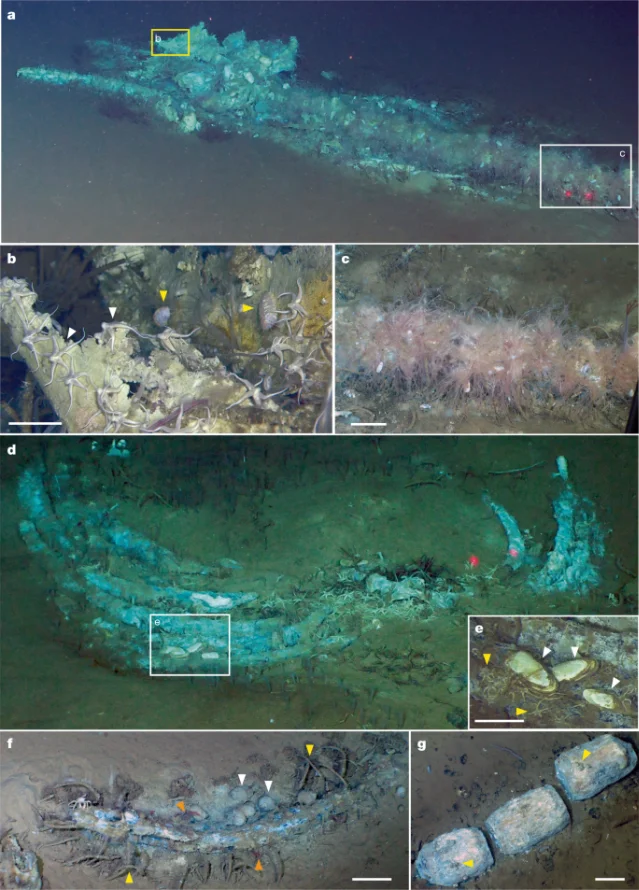
Core finding: During 32 dives of the crewed submersible Fendouzhe (HOV — human-occupied vehicle; rated to 10,000 m) between February and March 2023, researchers systematically surveyed approximately 0.64 km² of seafloor in the Diamantina Zone of the southeastern Indian Ocean at depths of 4,616–7,001 m. They documented 476 cetacean fossil specimens, five modern active whale-fall communities in the sulfophilic (bone-eating) phase, and a total extent of whale-fall habitat stretching approximately 1,200 km along the zone. 5
Strontium isotope (⁸⁷Sr/⁸⁶Sr) dating of the fossil assemblage places the oldest specimens at 5.26 Ma (early Pliocene), making this the earliest deep-sea whale-fall record. Fossil density reached 759.5 individuals/km²; whale-fall density was 7.81 occurrences/km². The fauna on and around the falls includes 35 large-animal taxonomic groups (>0.5 mm), most of which are likely undescribed species. Six cetacean taxa are represented, including one new species formally described in the paper: Pterocetus diamantinae sp. nov. (a beaked whale). The deepest recorded fossil is a beaked whale vertebra at 6,789 m. 5
What the density implies: The Diamantina Zone is a narrow, sediment-filled fault trough between two ancient continental fragments. Its geometry appears to funnel whale carcasses sinking from surface waters above a productive upwelling zone, producing fossil densities 2–3 orders of magnitude above those previously documented from isolated Pacific or Atlantic sites. The 5.3-million-year fossil record also preserves a long-term archive of cetacean community composition — including two extant beaked whale species (Mesoplodon bowdoini and M. layardii) alongside extinct genera — through successive ocean productivity regimes.
#4 — Microsoft and Quantinuum push trapped-ion logical error rates down by 11× to 800×
Journal: Nature Vol. 654, Issue 8118 (June 10, 2026) · DOI: 10.1038/s41586-026-10628-y
Discipline: Quantum computing / quantum error correction
Authors: Paetznick, Reichardt, Svore and collaborators — Microsoft / Quantinuum
Open access: No (paywalled)
Social signal: Zero observed X/Twitter posts within 48 h; paper published alongside other quantum-computing papers in same issue
Discipline: Quantum computing / quantum error correction
Authors: Paetznick, Reichardt, Svore and collaborators — Microsoft / Quantinuum
Open access: No (paywalled)
Social signal: Zero observed X/Twitter posts within 48 h; paper published alongside other quantum-computing papers in same issue
Core finding: On a trapped-ion Quantum Charge-Coupled Device (QCCD) processor, the Microsoft–Quantinuum team experimentally demonstrated two quantum error-correcting codes: a 12-qubit carbon code encoding 2 logical qubits (Knill-inspired design) and a 16-qubit tesseract color code encoding 4 logical qubits. Benchmarked against multiple physical-circuit baselines, logical error rates improved by 11× to 800× depending on operation and comparison baseline — a range reflecting both favorable gate-set properties and variability across the specific logical operations tested. The demonstration combines scalable error detection with post-selection, an approach designed to bridge current NISQ-era hardware toward fault-tolerant operation. 6
Context within the roadmap: The 11×–800× improvement figure is striking but warrants reading alongside the experimental conditions. The comparison baseline is physical circuit error rates on the same hardware, not an industry-standard cross-platform benchmark. Fault-tolerant quantum computation requires logical error rates below roughly 10⁻⁶ per operation; current physical trapped-ion gates operate near 10⁻³. The improvement reported here narrows that gap but does not yet achieve the threshold required for practical large-scale computation. The paper's contribution is demonstrating that both code types — differing in encoding overhead and decoding complexity — behave predictably on a real device, which is a necessary step before pursuing further qubit-count scaling.
No public resources: No GitHub repository, dataset, or demonstration code listed. Altmetric score: not available (48-hour window). 6
#5 — Scientists formally characterize the 481-meter Alaska tsunami that nearly hit a cruise corridor
Journal: Science Vol. 392, Issue 6803 (June 11, 2026) · DOI: 10.1126/science.aec3187
Discipline: Geohazards / seismology / glacial retreat
Lead author: Dan H. Shugar — University of Calgary
Co-authors: 18 authors from University of Calgary, USGS, University of Washington, Columbia University, UCL, University of Oxford, GEUS Denmark, University of Cambridge
Open access: No (paywalled); extensive public-interest coverage from Alaska Public Media, NASA Earth Observatory, Smithsonian Magazine
Social signal: Crossref early citation count: 3; Alaska Public Media coverage with survivor eyewitness accounts; NASA Earth Observatory published before-and-after Landsat imagery
Data: Zenodo · doi:10.5281/zenodo.18306727
Discipline: Geohazards / seismology / glacial retreat
Lead author: Dan H. Shugar — University of Calgary
Co-authors: 18 authors from University of Calgary, USGS, University of Washington, Columbia University, UCL, University of Oxford, GEUS Denmark, University of Cambridge
Open access: No (paywalled); extensive public-interest coverage from Alaska Public Media, NASA Earth Observatory, Smithsonian Magazine
Social signal: Crossref early citation count: 3; Alaska Public Media coverage with survivor eyewitness accounts; NASA Earth Observatory published before-and-after Landsat imagery
Data: Zenodo · doi:10.5281/zenodo.18306727
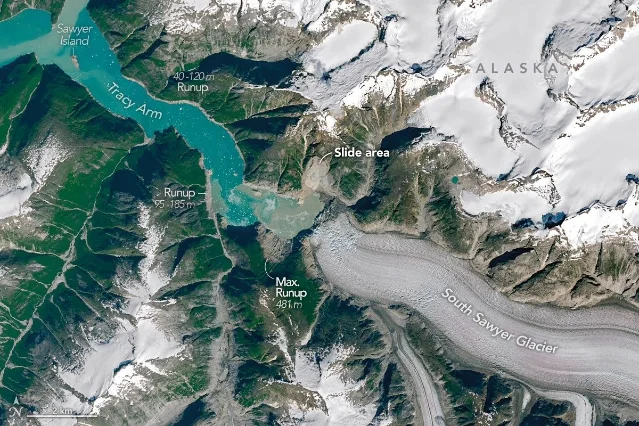
Core finding: At approximately 5:30 AM on August 10, 2025, more than 64 million m³ of rock failed from a cliff above Tracy Arm fjord in southeastern Alaska — a waterway visited by cruise ships throughout the summer season. The initial wave broke at roughly 100 m height and traveled at over 70 m/s, generating a runup of 481 m on the opposite fjord wall. The event generated long-period seismic waves equivalent to a Mw 5.4 earthquake, observable globally. A seiche (a standing wave that oscillates back and forth within an enclosed body of water) with a period of approximately 66 seconds became trapped in the fjord and persisted for up to 36 hours — only the second documented instance of a multi-day fjord seiche. 7 8
Precursory microseismicity: In the days before failure, seismic networks recorded a sequence of small earthquakes increasing in both rate and magnitude, with the sequence accelerating roughly one hour before the collapse. Alaska State Seismologist Michael West called the sequence "hundreds or thousands of very small ones" — a rare precursory pattern that was recorded but not acted upon in real time due to the absence of automated monitoring for landslide-seismicity in remote fjords. The paper argues this sequence could have provided a meaningful early-warning window under a monitoring system configured to detect it. 9
Near-miss context: Three kayakers camped on Harbor Island — Nick Heilgeist, Sasha Calvey, and Billy White — described being jolted awake with most of their gear swept into the water. 9 The event occurred at 5:30 AM; on most summer days, cruise ships transit Tracy Arm during daylight hours. West put the risk plainly: "We are in the rare position of being able to have these events that don't have truly catastrophic impacts, sometimes just because we can tuck them away in remote places. But they won't always be in remote places." 9
Climate connection: The paper documents that South Sawyer Glacier, whose retreat destabilized the slope above Tracy Arm, has retreated significantly in recent decades — with the accelerating debutressing of rock walls as a consequence. The hazard is not unique to Tracy Arm: glacial retreat has exposed steep, freshly deglaciated rock faces at hundreds of fjord systems in Alaska, British Columbia, Norway, Greenland, and Patagonia, many of which receive vessel traffic.
Cover image: AI-generated illustration.
参考来源
- 1Measurement of reactor neutrino oscillation with the first JUNO data
- 2Fast cell wall softening causes Venus flytrap closure
- 3How do Venus flytraps work? New study sheds light on cellular mechanisms
- 4Scientists reveal surprising mechanism behind Venus flytrap's rapid snap
- 5A 5.3-million-year-old deep-sea whale necropolis in the Diamantina Zone
- 6Improved quantum processor logical error rates via correction and detection
- 7A 481-meter-high landslide-tsunami in a cruise ship–frequented Alaska fjord
- 8Tracy Arm's Post-Tsunami Landscape
- 9'Pure chaos out of nowhere': Mega-landslide and tsunami rip through Tracy Arm south of Juneau
围绕这条内容继续补充观点或上下文。